Nobody scrutinises a label like a parent buying for a newborn. They read the ingredient list, check for fragrance, look at who made it. That makes baby care one of the hardest categories to enter and one of the most rewarding to get right. If you are looking for a baby care third party manufacturer Kolkata brands can trust, the factory you choose will shape your reputation more than your packaging ever will.
This guide covers how contract manufacturing for baby products works in India, which rules matter most, what a careful factory should be doing, and where D10 Enterprises fits if you build your brand in Kolkata and manufacture elsewhere.
Why Kolkata Brands Manufacture Outside the City
Kolkata has a loyal, brand aware customer base and a strong habit of trusting products that feel gentle and familiar. What it does not offer is affordable industrial space for clean mixing rooms, filling lines and proper storage. So most baby care brands in the city run sales and marketing locally and use a licensed factory in another state for production.
D10 Enterprises works from Ajit Nagar, Ambala Cantt, Haryana, and has no unit in Kolkata. Baby care is a category where you will want samples in your hands, documents on your desk and clear answers on the phone, whatever the distance.
What Baby Care Contract Manufacturing Covers
A contract infant product producer makes your product in its own licensed facility and gives you finished, labelled stock. You keep the brand and the customer. Baby care usually means shampoos, washes, lotions, oils, creams and powders. D10 lists baby products as a manufacturing category, alongside personal care, hair care and cream. You can see the wider range in the product catalog.
The Rules That Matter Most for Baby Products
Baby products sold in India are cosmetics, governed by the Drugs and Cosmetics Act, 1940 and the Cosmetics Rules, 2020. The Rules include a licence category for infant skin powder, and baby shampoo is one of the products covered by the BIS product standards listed in the Ninth Schedule. Those standards set limits on ingredients, microbes and heavy metals.
Two details are worth knowing. First, microbial limits are tighter for baby products. One regulatory database notes a cap of 1000 CFU per gram or millilitre for shampoos and powders in general, against 100 for baby products. Second, powdery products meant for children under three carry a label warning to keep the powder away from the child’s nose and mouth. A careful factory will build both into its process and artwork checks.
Also, a baby product claim should stay gentle and cosmetic. “Mild” or “tear free” language needs backing from testing, and anything that sounds like treating a skin condition can push a product toward drug rules. D10 lists regulatory operations and support and a quality, safety and compliance programme, so raise label claims in your first call.

What Safe Manufacturing Services Should Look Like
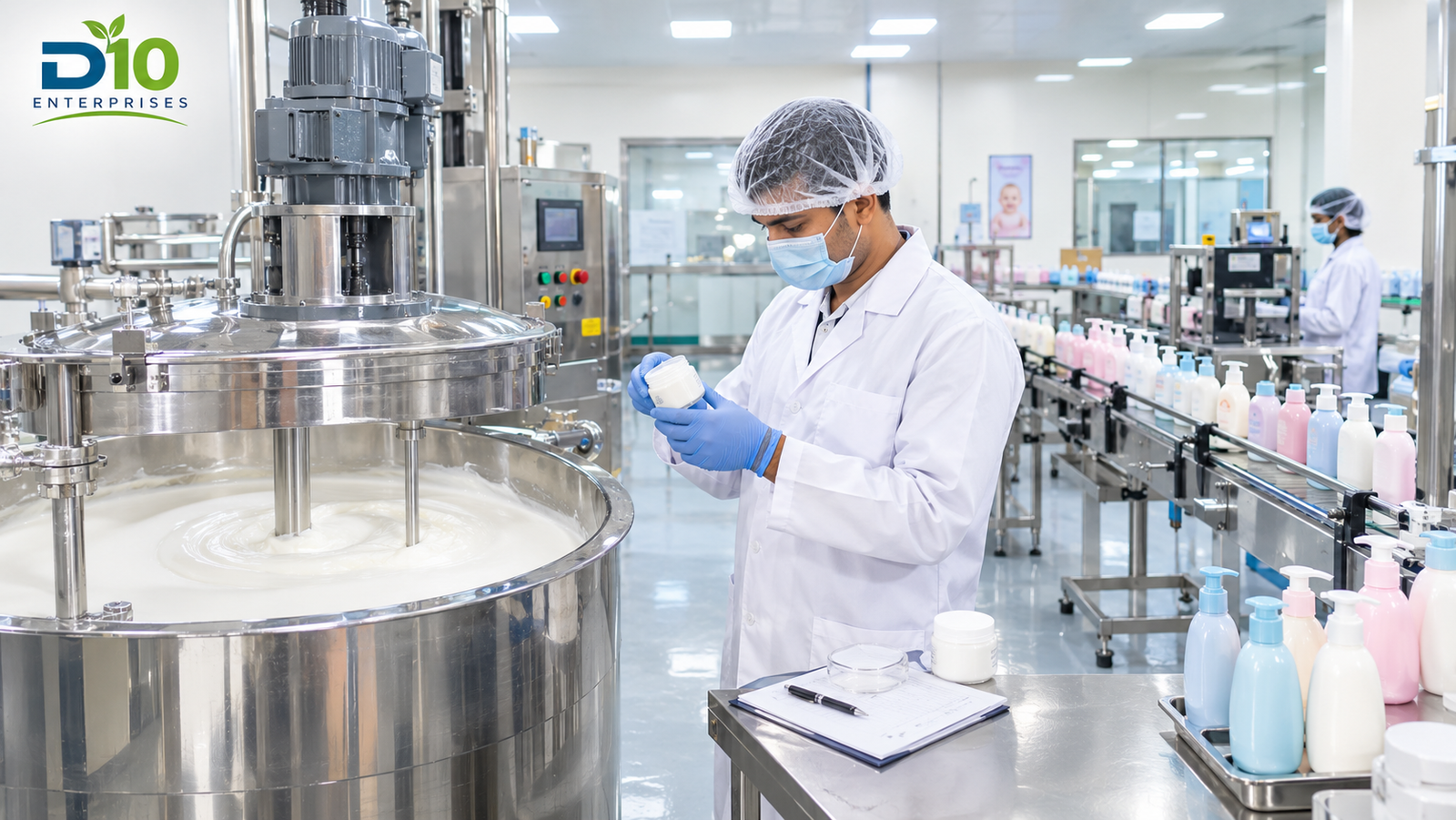
“Safe” is a word every factory uses. The useful question is what it looks like in practice. For baby care, look for a valid cosmetics manufacturing licence, a clean, documented production area, controlled raw material sourcing, microbial testing on finished batches, and batch records that let any bottle be traced back to its batch. Ask to see these, not just hear them.
D10 describes its work as GMP standard production with quality control. It is reasonable to ask which tests are done on a baby product batch before release, and to ask for a certificate with each batch.
White Label Baby Cosmetics Versus Custom Formulation
White label baby cosmetics means choosing a gentle formula the manufacturer already makes, such as a mild shampoo or a lotion, and putting your brand on it. It is faster, cheaper to start and has lower minimum orders, which suits a new brand testing the market.
Custom formulation builds a formula around your brief: fragrance free, plant based oils, a specific texture. It takes longer and needs more sample rounds, and for baby products those rounds should include patch style safety checks and stability tests. D10 lists custom formulation solutions and private branding and labeling as separate services.
Loan Licensing for Later
As your brand grows you may want to hold your own licence. D10 lists loan licensing services, where you hold the manufacturing licence and use an already licensed factory’s equipment and staff. Most first launches start with plain contract manufacturing instead.
How the Process Usually Runs
You send a brief: product type, age group, ingredient preferences, fragrance choice, pack style and first order size. The manufacturer proposes a formula and samples. You review texture, smell and feel, and ask for changes. After approval, packaging and label artwork are checked against labelling rules and warnings. Production runs in batches, each batch is tested and released, and stock is dispatched.
For a Kolkata brand, ask how bottles are packed for freight. Baby lotions and oils leak easily, and a damaged carton costs you more than money.
Questions to Ask a Child Care Contract Manufacturer
- Do you hold a valid cosmetics manufacturing licence covering baby products?
- How do you meet the BIS standards that apply to baby shampoo or powder?
- What microbial testing do you run on each batch?
- Have you made a formula like mine before?
- What is the minimum order quantity?
- How many sample rounds are included?
- How do you pack stock to avoid leaks in transit to Kolkata?
What Shapes the Price
Cost depends on the ingredients, whether the formula is fragrance free or uses premium oils, batch size, bottle or tube type, caps and pumps, label printing, testing and freight. Testing and quality control cost money, so a very low quote on a baby product deserves a second look. Ask for a written breakdown by stage.
Common Mistakes
The first is choosing on price alone. The second is adding too many claims, such as “dermatologist tested” or “hypoallergenic”, without proof to back them. The third is skipping stability testing, so a lotion separates or smells off after a few weeks. The fourth is launching a big range at once. One or two products teach you more.
Getting Started
Before contacting any manufacturer, write a short brief: product type, target age, ingredient preferences, fragrance choice, pack style, first order size and launch date.
To speak with D10 Enterprises, read the about page first, then reach them through the contact page, by phone on +91-7988374621, or by email at d10enterprisesambala@gmail.com. The address is 226/2 and 226/3, Ajit Nagar, Ambala Cantt, Haryana 133001. You can also start from the D10 Enterprises homepage.