Most Delhi founders do not struggle to find a manufacturer. They struggle to tell the good ones from the rest. Every listing promises quality, low minimums and fast delivery, and the differences only show up months later, when a batch tastes different, a label gets questioned or a delivery slips. If you are comparing a supplement third party manufacturer in Delhi, a clear checklist is worth more than a long shortlist supplement third party manufacturer delhi.
This guide is about choosing, not just about how manufacturing works. It covers the rules that decide what you can put in a product and on a label, how to match the format to your customer, how to compare quotes, and where D10 Enterprises fits for a Delhi brand.
Why Delhi Supplement Brands Manufacture Outside the City
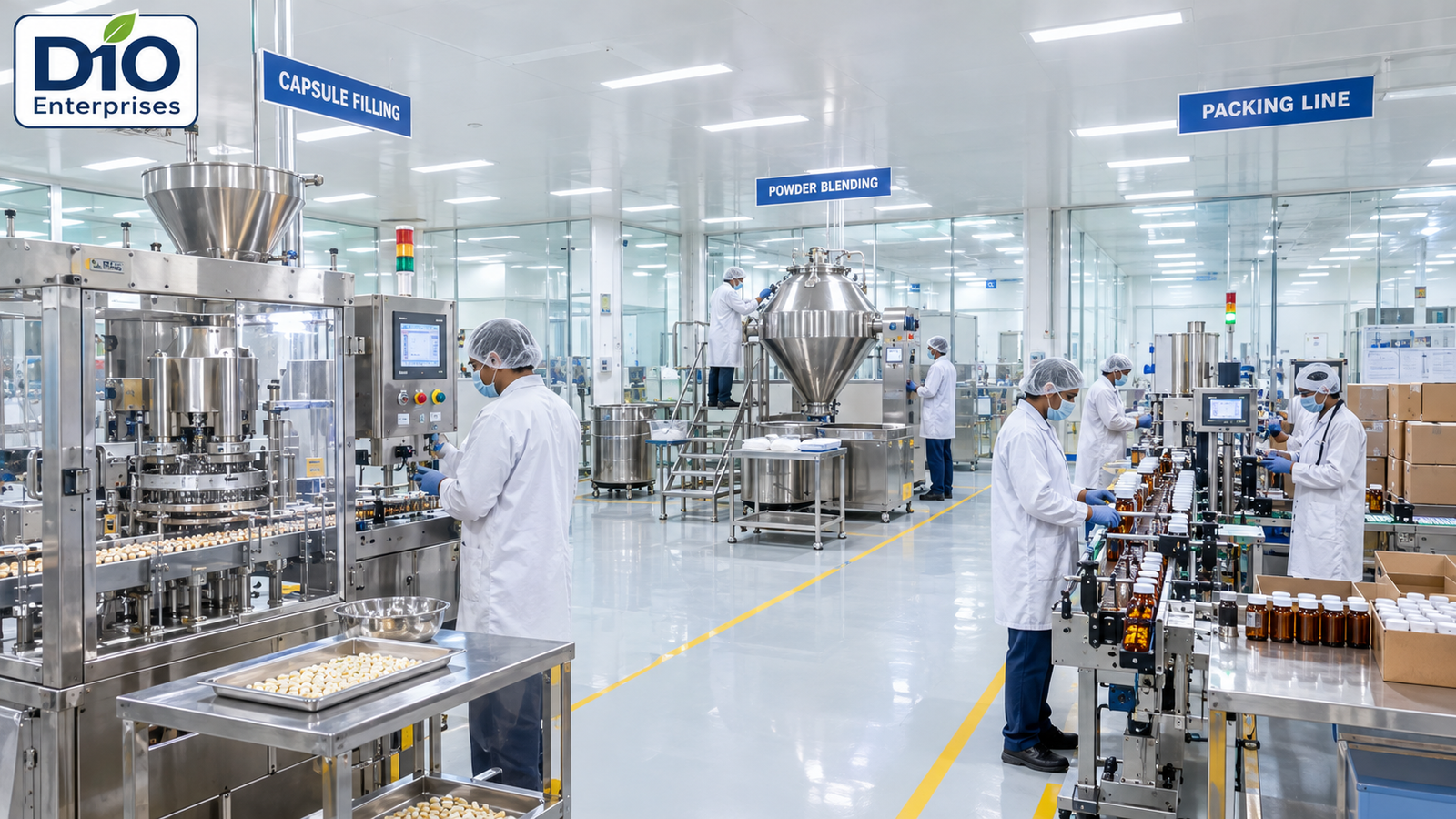
Delhi NCR has a big, health aware customer base, a busy gym and wellness scene and strong online selling. Space for clean production halls, blenders and packing lines is another matter. Most supplement brands in the capital region handle branding and sales at home and use a licensed factory elsewhere.
D10 Enterprises works from Ajit Nagar, Ambala Cantt, Haryana, and has no Delhi facility. Its site describes it as a third party manufacturer across cosmetics, dermatology, nutraceuticals and herbal products. What matters for you is whether a factory communicates clearly, shares documents and ships when promised.
Start With the Rules, Because They Shape Everything
Supplements in India are regulated as food, under the Food Safety and Standards (Health Supplements, Nutraceuticals, Food for Special Dietary Use, Food for Special Medical Purpose, and Prebiotic and Probiotic Food) Regulations, 2022. These replaced the 2016 version.
A few points matter to you directly. Ingredients must come from the schedules in the regulations, which cover nutrients such as vitamins, minerals and amino acids, and plant or botanical ingredients. If an ingredient is not listed or permitted for health supplements, FSSAI approval is needed before the product can be made. Labels must carry the warning “NOT FOR MEDICINAL USE” in capital, bold letters. And claims are limited: nutritional and health claims listed in the Advertising and Claims Regulations are allowed, while anything else needs prior approval.
In plain words, your formula idea and your marketing copy both have limits, and a good manufacturer should tell you early, not after you have printed ten thousand labels. Also, health supplement manufacturing falls in FSSAI’s mandatory Central License category, so ask any factory to show its licence. D10 lists regulatory operations and support and a quality, safety and compliance programme, and it is fair to ask what exactly they handle.
Match the Format to the Customer
Format is a business decision as much as a technical one. D10’s nutraceuticals manufacturing page lists syrup, softgel capsules, protein powders and mouth spray. The nutraceutical catalogue shared by the company also covers tablets and capsules, sachets, syrups, powders and oral spray, and gummies are part of what D10 makes as well. The product catalog shows the wider range.
Think about who buys. Gym customers tend to want powders. Busy professionals like tablets and capsules because they are quick. Oil based vitamins suit softgels. Younger buyers and people who dislike pills lean toward gummies or sprays. A factory that offers several formats lets you add a second product later without finding a new partner, which saves time on every re-approval.
White Label or Custom: A Simple Way to Decide
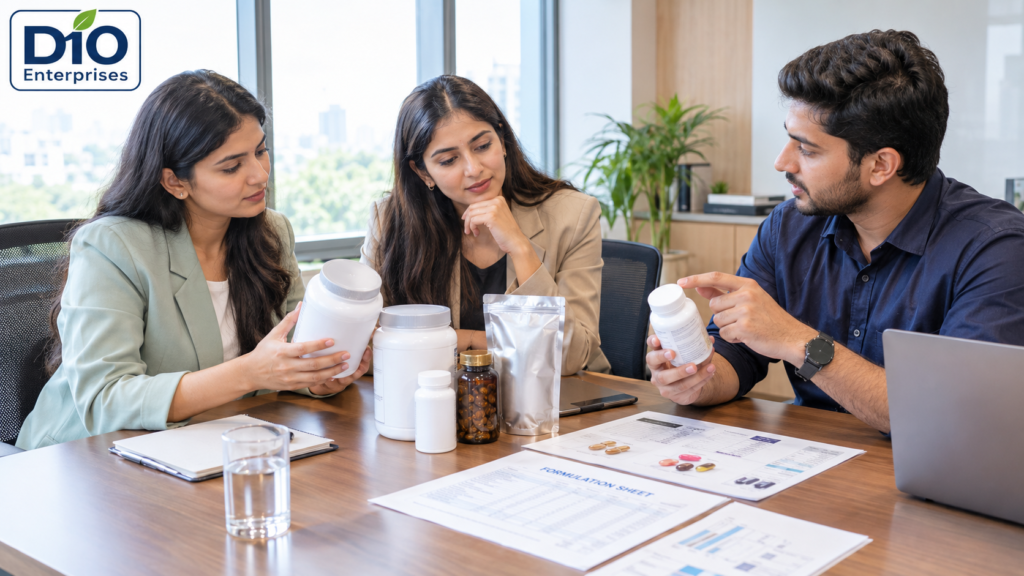
White label dietary services mean using a formula the manufacturer already makes under your brand. It is the cheaper, faster start, with lower minimum orders and no development time.
Custom formulation means a formula built for your brief. It costs more and takes longer, but the product is yours alone. A fair rule: go white label if your edge is brand, content or distribution, and go custom if your edge is the formula itself. D10 lists custom formulation solutions and private branding and labeling as separate services, so you can begin with one and add the other.
If you later want to hold your own licence, D10 also lists loan licensing services.
How to Compare Two or Three Manufacturers Fairly
Put the same brief in front of each one and compare the answers on the same points.
| Point to check | What a good answer looks like |
|---|---|
| Central FSSAI licence | Shown on request, covers supplements |
| Experience with your format | They have made similar products before |
| Ingredient check | They tell you early if something is not permitted |
| Minimum order quantity | Clear, and fits your launch budget |
| Samples | Quick, with room for revisions |
| Testing | Batch certificate of analysis available |
| Label support | They review claims and warnings |
| Dispatch to Delhi NCR | A realistic time, with packing details |
A factory that answers all of these without hedging is usually a safer bet than one that jumps to a price.
How the Process Usually Runs
You send a brief: format, ingredients, target customer, pack style and first order size. The manufacturer checks the formula against the permitted lists, proposes a recipe and sends samples. After approval, packaging and label artwork are finalised and reviewed against the labelling rules. Production runs in batches, each is tested, and the stock is dispatched.
For a Delhi brand, ask about dispatch timing and packing. Your own launch and restocking plans depend on it far more than most people expect.
What Shapes the Price
The main drivers are the ingredients and their doses, the format, batch size, packaging, label printing, testing and freight. Packaging and testing are often where a very low quote cuts corners. Ask for a written breakdown by stage so you can compare quotes on equal terms.
Common Mistakes
The first is choosing a manufacturer on price alone. The second is writing marketing copy before checking what claims are allowed. The third is skipping samples or approving after one try. The fourth is ordering a large first batch before the product has sold. The fifth is launching with too many products at once.
Getting Started
Before contacting any manufacturer, write a short brief: format, key ingredients, target customer, pack style, first order size and launch date.
To speak with D10 Enterprises, read the about page first, then reach them through the contact page, by phone on +91-7988374621, or by email at d10enterprisesambala@gmail.com. The address is 226/2 and 226/3, Ajit Nagar, Ambala Cantt, Haryana 133001. You can also start from the D10 Enterprises homepage.