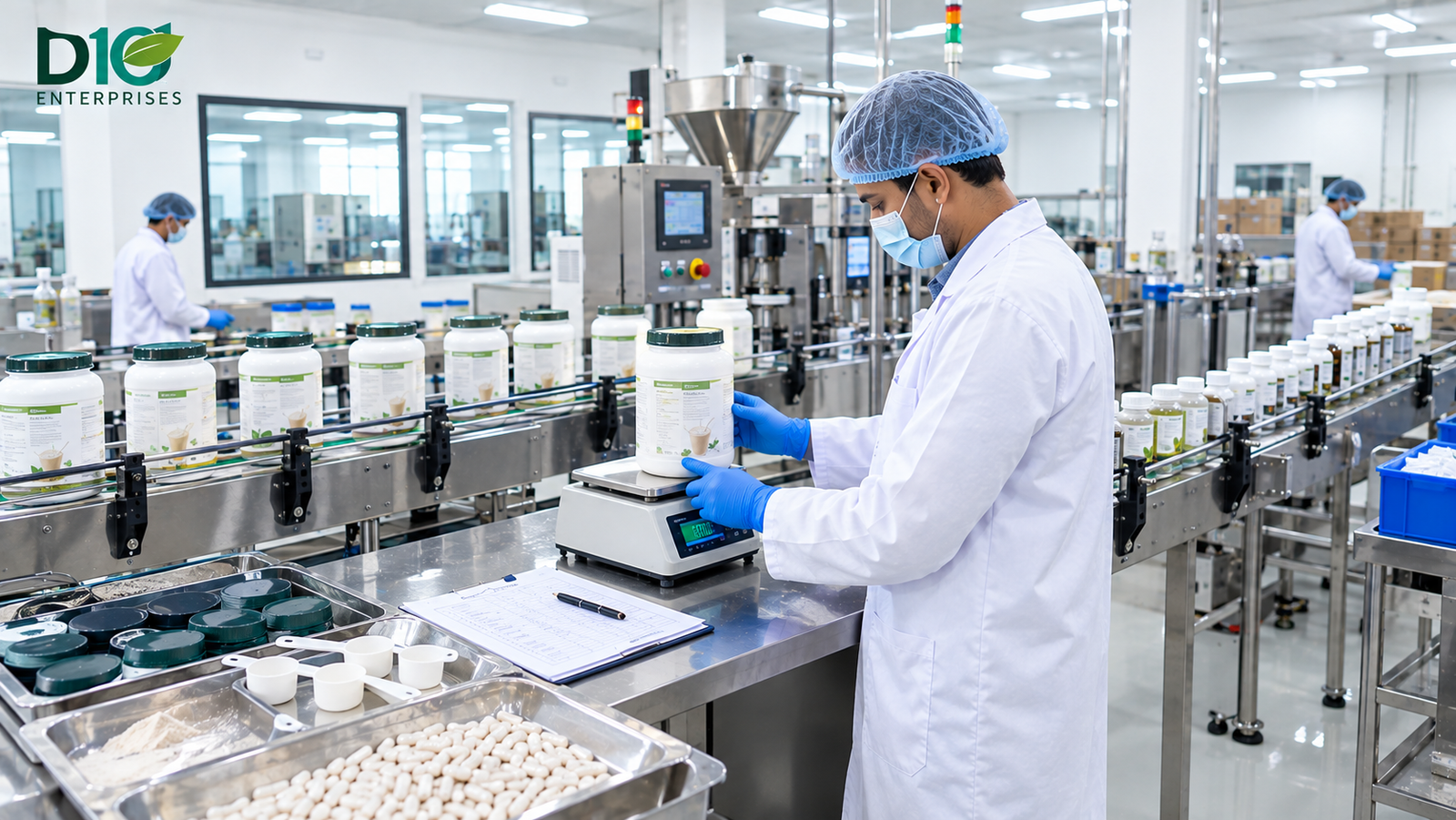
Weight management is one of the most searched supplement categories in India and one of the most closely watched. Customers are hopeful, competitors are loud and regulators have taken a firm line on what a label may promise. If you are looking for a weight management third party manufacturer Mumbai brands can work with, the factory matters, but the wording on your pack matters just as much.
This guide covers how contract manufacturing works for weight management products, what the rules say about claims, how to choose a format, how to market responsibly and what to ask D10 Enterprises if you plan to build your brand in Mumbai and manufacture elsewhere.
Why Mumbai Brands Manufacture Outside the City
Mumbai has the customers, the pharmacies, the gyms and the online sellers a wellness brand needs. It does not have affordable space for clean blending rooms, capsule lines and packing halls. So most supplement brands in the city run marketing and sales locally and use a licensed factory in another state.
D10 Enterprises works from Ajit Nagar, Ambala Cantt, Haryana, and has no Mumbai unit. For a brand owner, what counts is honest communication, good samples and dispatch that arrives on time.
What the Rules Say About Weight Claims
Weight management supplements are health supplements, so they follow FSSAI’s Nutra Regulations, 2022. A health supplement label must carry the words “HEALTH SUPPLEMENT” in capital, bold letters close to the product name. Nutritional and health claims listed in the Advertising and Claims Regulations, 2018 are allowed, and any other claim needs prior approval from the Food Authority. Guidance from regulatory consultants adds that a health supplement cannot claim to cure, treat or prevent any disease.
There is a second law in the background. Courts in India have treated product labels as advertisements under the Drugs and Magic Remedies (Objectionable Advertisements) Act, 1954, and in one case discussed claims about correcting obesity on a label under that Act. In practice, wording such as “cures obesity” is dangerous territory.
Enforcement is current. This month, FSSAI issued show-cause notices over a protein supplement’s marketing. The regulator said that describing a powder as complete daily nourishment improperly suggested a meal replacement, and that pairing a product name with “GLP+” implied an approved link with prescription anti-obesity drugs. Promoting prescription weight-loss drugs to the public is also restricted under the Drugs and Cosmetics Act, 1940, so never reference prescription medicines on a label or in an advertisement.
The practical rule is to decide your claims with your manufacturer before you design packaging. D10 lists regulatory operations and support and a quality, safety and compliance programme, so ask exactly what they review. Also ask to see the factory’s licence. Health supplement manufacturing falls in FSSAI’s mandatory Central License category.

What D10 Lists, and What to Confirm
According to its website, D10 Enterprises lists nutraceutical formats on its nutraceuticals manufacturing page: syrup, softgel capsules, protein powders and mouth spray. The nutraceutical catalogue shared by the company also covers tablets and capsules, sachets and oral spray, and gummies are part of what D10 makes as well. The product catalog shows the wider range.
None of the public pages describes a weight management range. So treat that as your first question: ask whether D10 has worked with the ingredient types you have in mind, and ask for samples before you commit.
Ingredients: Only What Is Permitted
Ingredients in a health supplement must come from the permitted schedules of the 2022 regulations, and an ingredient that is not listed needs FSSAI approval first. Weight management products attract unusual ingredients, so this is where many brands run into trouble. Ask your manufacturer to check every ingredient and its amount against the schedules before you invest in samples or packaging.
Choosing a Format
Powders and sachets suit meal-style products and larger doses. Capsules and tablets are compact and stable, but a full serving may need several. Gummies appeal to people who dislike pills, though each piece holds only a small dose. Pick the format your customer already uses and check that the dose per serving matches what you plan to say.
White Label Weight Loss Services Versus Custom Formulation
White label weight loss services mean choosing a formula the manufacturer already makes and putting your brand on it. It is quicker, with lower minimum orders and no development time.
Custom formulation builds a blend around your brief. It takes longer and needs more sample rounds, particularly for taste. D10 lists custom formulation solutions and private branding and labeling as separate services. If you later want your own licence, it also lists loan licensing services.
Marketing This Category Responsibly
Weight loss messaging reaches vulnerable people, including those with an unhealthy relationship with food. A responsible brand avoids promises of fast or extreme results, avoids before and after imagery and avoids targeting young people. It also encourages customers with medical conditions or those taking prescription medicines to speak to a doctor first. This is good ethics and it also lowers your regulatory risk.
How the Process Usually Runs
You send a brief: format, ingredients, target customer, pack style and first order size. The manufacturer checks ingredients against the permitted lists, proposes a recipe and sends samples. After approval, packaging and label artwork are finalised and your claims are reviewed. Production runs in batches, each is tested, and finished stock is dispatched.
For a Mumbai brand, ask about packing for humid weather. Powders absorb moisture, so sealed tubs and desiccants matter through the monsoon.
Questions to Ask a Contract Diet Supplement Producer
- Do you hold a Central FSSAI licence covering health supplements?
- Have you worked with my kind of ingredients before?
- Will you check every ingredient against the permitted schedules?
- Will you review my label wording and claims before printing?
- How do you check dose accuracy and stability?
- What is the minimum order quantity for a first batch?
- How long does dispatch take, and how do you pack for Mumbai’s climate?
What Shapes the Price
Cost depends on the ingredients and their quality, the format, batch size, packaging, label printing, testing and freight. Ask for a written breakdown by stage so you can compare quotes properly.
Common Mistakes
The first is writing dramatic claims before checking what is allowed. The second is using an ingredient that is not on the permitted list. The third is referring to prescription drugs or implying a link with them. The fourth is calling a powder a complete meal without checking the rules. The fifth is picking a factory on price without seeing its licence.
Getting Started
Before contacting any manufacturer, write a short brief: format, key ingredients, target customer, claims you hope to make, pack style, first order size and launch date.
To speak with D10 Enterprises, read the about page first, then reach them through the contact page, by phone on +91-7988374621, or by email at d10enterprisesambala@gmail.com. The address is 226/2 and 226/3, Ajit Nagar, Ambala Cantt, Haryana 133001. You can also start from the D10 Enterprises homepage.