If you are starting a fitness brand in Bangalore, the product is usually the easy part to imagine. A tub of whey, a plant protein for vegetarians, maybe a mass gainer for the gym crowd. The hard part is finding someone to actually make it, in a clean facility, to the flavour you want, at a batch size you can afford. Searching for a protein powder third party manufacturer Bangalore founders can rely on quickly turns into a pile of listings that all promise the same thing.
This guide walks through how contract manufacturing for protein powders really works in India, what the food safety rules expect from you, which questions separate a serious factory from a trader, and where D10 Enterprises fits if you want to build your brand in Bangalore and get the production done elsewhere.
Why Bangalore Brands Rarely Manufacture in the City
Bangalore is a good place to launch a supplement brand. There are gyms in almost every neighbourhood, a large working population that cares about fitness, and a strong start-up culture that makes it easy to find designers, photographers and marketers. What the city does not offer is cheap factory space with the equipment needed for powder blending and filling.
So the usual setup is simple. You run the brand, the marketing and the sales from Bangalore. A licensed factory somewhere else handles production. D10 Enterprises is one such factory. It is based at Ajit Nagar, Ambala Cantt, Haryana, and it does not have a unit in Bangalore. That is worth saying clearly, because some manufacturers hint at local presence they do not have. For a brand owner, the useful question is not where the factory is. It is whether samples, approvals and dispatch can be managed smoothly by phone, email and courier.
What Protein Powder Contract Manufacturing Actually Covers
A contract supplement maker produces your product in its own facility, under its own food licence, and hands you finished, labelled stock. You keep the brand, the customers and the marketing. You do not own the plant.
There are usually two ways to begin. One is to pick a ready formula from the manufacturer’s range and put your label on it, which is what most people mean by white label production services. It is quicker and needs less money up front, though the same base may be sold to other brands. The other is a custom formula built around your brief: a specific protein blend, a lower sugar version, or a flavour profile that suits Indian taste better than the imported tubs on the shelf.
D10 lists both routes as separate services on its site. You can read about custom formulation solutions and private branding and labeling before you decide which one suits your budget.
What D10 Enterprises Lists for Nutraceuticals
According to its website, D10 Enterprises works across cosmetics, dermatology, nutraceuticals and herbal medicines. Under nutraceuticals, the listed formats are syrup, softgel capsules, protein powders and mouth spray. The nutraceuticals manufacturing page is the place to see the range, and the product catalog shows the wider list.
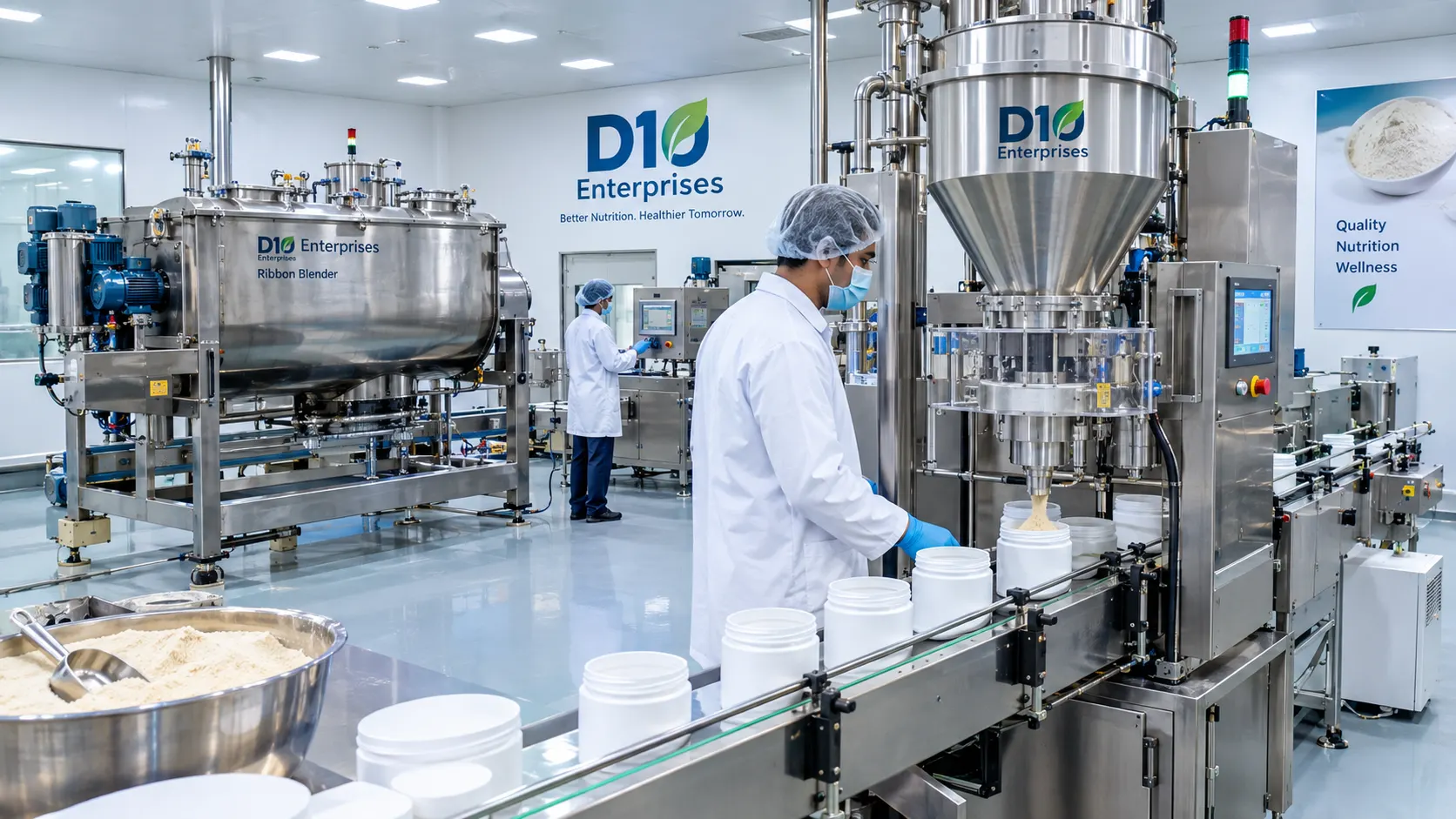
For a fitness supplement contract manufacturer, format matters more than most people think. Powder production is a very different job from softgels or syrups. It needs accurate blending so that every scoop has the same amount of protein, careful control of moisture so the powder does not clump, and clean filling equipment. Before you sign anything with any factory, ask whether they make powders on a regular basis or only occasionally.
The Food Safety Rules You Cannot Skip
Protein powders in India fall under food safety law, not the cosmetics or drug rules people sometimes confuse them with. Health supplements and nutraceuticals are covered by the Food Safety and Standards (Health Supplements, Nutraceuticals, Food for Special Dietary Use, Food for Special Medical Purpose, Functional Food and Novel Food) Regulations, 2016. FSSAI’s own guidance says re-labellers must make sure their third party manufacturers hold a valid FSSAI licence for manufacturing the same product. fssai
In plain terms, if you are the brand owner and a factory makes your powder, you should ask to see that factory’s licence and check that it covers the product you want. Do not accept a verbal assurance. It also helps to know that protein powders are named among the products regulated under these supplement rules. brandchanakya
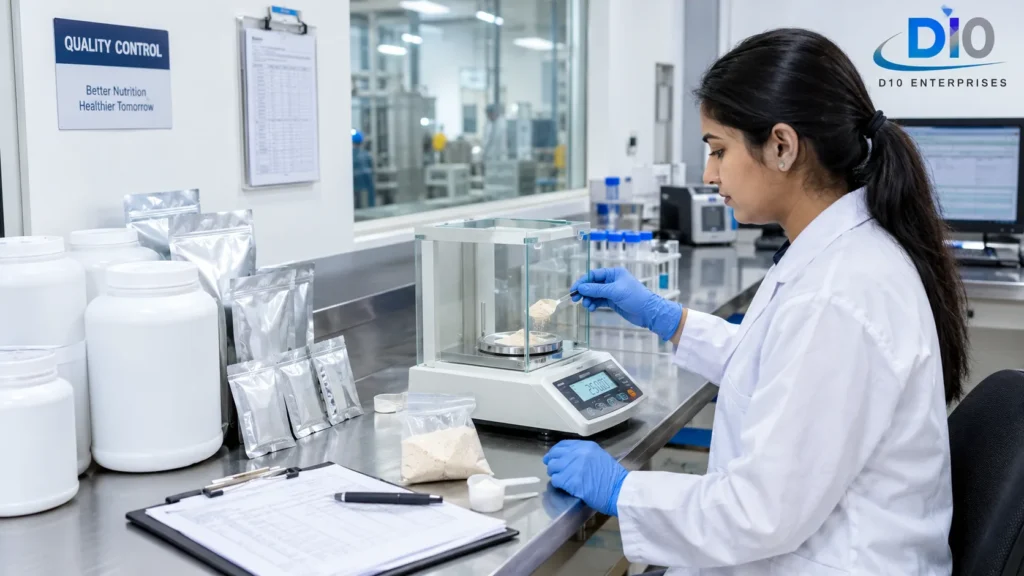
Labels matter as much as licences. Supplement labels are expected to carry the manufacturer’s details, the FSSAI licence number, a batch number and an expiry date, along with usage instructions. Get your artwork reviewed against these requirements before printing, because a wrong label on ten thousand tubs is an expensive mistake. wjarr
D10 also lists regulatory operations and support and a quality, safety and compliance programme as services. It is fair to ask them exactly which documents they handle and which ones stay with you.
Loan Licensing Versus Plain Contract Manufacturing
Some founders want more control over the regulatory side. D10 offers loan licensing services alongside its standard contract manufacturing. With plain contract manufacturing, the factory stays the licence holder and you simply buy the finished goods. A loan licence structure gives you more ownership but also more paperwork. If you are a first-time founder in Bangalore, plain contract manufacturing is usually easier to start with. You can revisit the other model once the brand is selling steadily.
How the Process Usually Runs
Almost every project follows a similar path, whatever the factory.
You start with a brief: the type of protein, target customer, flavours, pack sizes and rough first order. The manufacturer proposes a formula and sends samples. You taste them, ask for changes and approve one. Then you finalise packaging, be it tubs, pouches or sachets, and get the label artwork checked. Production goes ahead in batches, with testing before release, and the stock is dispatched to you.
For a Bangalore brand, the stage worth planning around is dispatch. Ask how long a typical batch takes from approval to shipping, how the goods travel, and who is responsible if a carton arrives damaged. Delays in freight can hold up a launch as much as delays in production.
Questions to Ask a Bulk Manufacturing Supplier
When you compare a bulk manufacturing supplier with a small-batch maker, the differences show up in a few basic questions:
- Do you hold a valid food licence that covers protein powders, and can I see it?
- Have you produced this exact type of powder before?
- What is the minimum order quantity for a first batch?
- Do you send a certificate of analysis with each batch?
- What do you do about allergen handling and cross contact?
- Who arranges packaging materials, and who checks the label?
- What is the typical time from approved sample to dispatch?
A factory that answers these directly, without hedging, is usually more reliable than one that jumps straight to a price.
What Affects the Price
Nobody can give you an honest number without knowing the product. The main factors are the protein source and quality, added ingredients like vitamins or digestive enzymes, flavouring, the size of the batch, the type of packaging, printing, testing and freight. Founders often compare only the price per kilo and forget that packaging and shipping can make a real difference to the final cost per tub.
Ask for a written breakdown that separates the formula, filling, packaging, labelling and testing. It makes two quotes far easier to compare.
Mistakes First-Time Fitness Brands Make
The most common one is choosing on price. A very cheap quote often means a stock formula, weak testing or missing paperwork. Another is skipping samples, or approving one after a single taste. Taste and texture change with mixing ratio and storage, so ask to try more than one batch if you can.
A third mistake is launching with too many flavours and sizes. Start with one or two products, watch what sells in Bangalore and online, and add later. And do not leave the label until the end. It needs checking early, as covered above.
Getting in Touch
Before contacting any manufacturer, write a short brief covering your product, target customer, flavours, pack sizes, expected first order and launch timeline. It lets the factory tell you honestly whether they are a good fit.
If you would like to talk to D10 Enterprises, read the about page first, then reach them through the contact page, by phone on +91-7988374621, or by email at d10enterprisesambala@gmail.com. The address is 226/2 and 226/3, Ajit Nagar, Ambala Cantt, Haryana 133001. You can also start from the D10 Enterprises homepage.
Frequently Asked Questions
Is there a factory in Bangalore for this?
D10 Enterprises does not have one. It is based in Ambala Cantt, Haryana, and works with brand owners in other cities remotely.
Does D10 make protein powders?
Protein powders are listed under its nutraceuticals range on the website. Ask for current availability and formats when you enquire.
What is white label production?
It means you sell a ready-made formula under your own brand name, rather than developing one from scratch.
Can I have my own brand on the tub?
Yes. Private branding and labeling is listed as a service on the D10 website.
Do I need to check the factory’s licence?
Yes. FSSAI guidance expects brands to ensure their third party manufacturers hold a valid licence for the product being made.
What should my first order look like?
Keep it small and focused. One or two products lets you test the market before you commit to a wider range.