Kolkata has a long relationship with Ayurveda and herbal wellness, so it is no surprise that more entrepreneurs from the city are starting herbal supplement and tonic brands. The tricky part usually shows up right after the brand name and packaging design are finalised. You need someone to actually make the product, under the right licence, to a formula that holds up over its shelf life. Searching for a herbal supplement third party manufacturer Kolkata founders can trust often turns up a mix of traders, agents and the odd genuine manufacturer, with very little to tell them apart at first glance.
This guide explains how herbal and Ayurvedic contract manufacturing works in India, what licence actually matters here, and what to check before you commit to a factory. It also looks at where D10 Enterprises fits if you are building your brand from Kolkata and manufacturing elsewhere.
Why Herbal Brands from Kolkata Manufacture Outside the City
Kolkata has strong demand for herbal tonics, powders and Ayurvedic formulations, shaped by a customer base that already trusts these categories. What it does not have in large supply is industrial land suited to herbal extraction and formulation, which needs space for raw material storage, extraction equipment and separate finished goods areas.
Because of that, most Kolkata based herbal brands run their business locally and manufacture through a facility in another state. D10 Enterprises, based at Ajit Nagar, Ambala Cantt, Haryana, is one such option. It has no unit in Kolkata, and any manufacturer that hints otherwise is worth questioning. What actually decides whether the relationship works is communication, sample turnaround and how reliably the finished stock reaches you.
Herbal, Ayurvedic and Nutraceutical: Getting the Category Right
Before you approach a manufacturer, it helps to know which category your product falls under, because the rules differ.
Classic herbal medicines and Ayurvedic formulations, things like tonics, churnas and herbal tablets marketed with traditional therapeutic claims, generally fall under AYUSH regulation. Herbal products marketed as general food supplements or nutraceuticals, without therapeutic claims, usually fall under food safety rules instead. Getting this classification wrong at the start can cause real problems later, since it decides which licence your manufacturer needs to hold for your product.
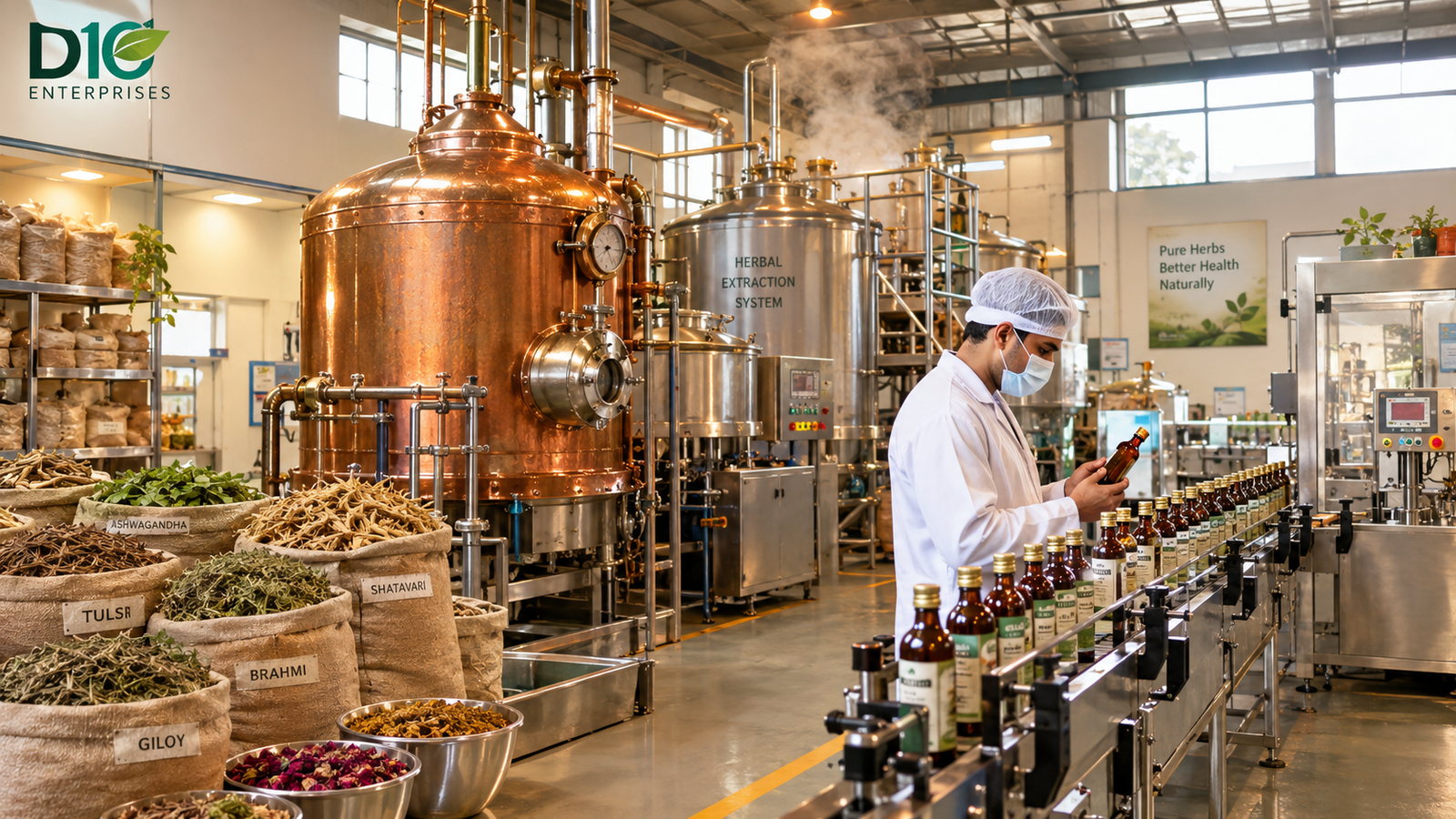
D10 Enterprises lists a herbal medicines range on its site covering syrup, tonics, tablets and powder, alongside a separate herbal cosmetics line. You can see the manufacturing categories on its manufacturing page and the herbal listing under herbal medicines.
The Licence That Actually Matters Here
For herbal and Ayurvedic products, the relevant licence is an AYUSH licence, issued under the Drugs and Cosmetics Rules, 1945, by the state AYUSH authority where the manufacturing unit is based. There are two main types worth knowing. An AYUSH manufacturing licence covers a company producing on its own premises, filed using Form 24D. An AYUSH loan licence allows a brand to manufacture using another company’s already licensed facility, filed using Form 25E, and it does not require the brand to hire its own Ayurvedic experts or pharmacists since the manufacturing unit already has them in place.
This is directly relevant if you are working with a third party manufacturer. When you use a contract manufacturer under a plain arrangement, the factory holds the AYUSH manufacturing licence and produces on your behalf. If you want more ownership of the regulatory side, a loan licence lets you hold a licence yourself while still using their facility and equipment. D10 lists loan licensing services separately from standard contract manufacturing, so you can choose based on how much you want to handle yourself.
Whichever route you take, ask to see the manufacturing unit’s current AYUSH licence and confirm it covers the specific product category you plan to sell. A licence for tablets does not automatically cover tonics or powders.
What Contract Medicine Producer Services Usually Include
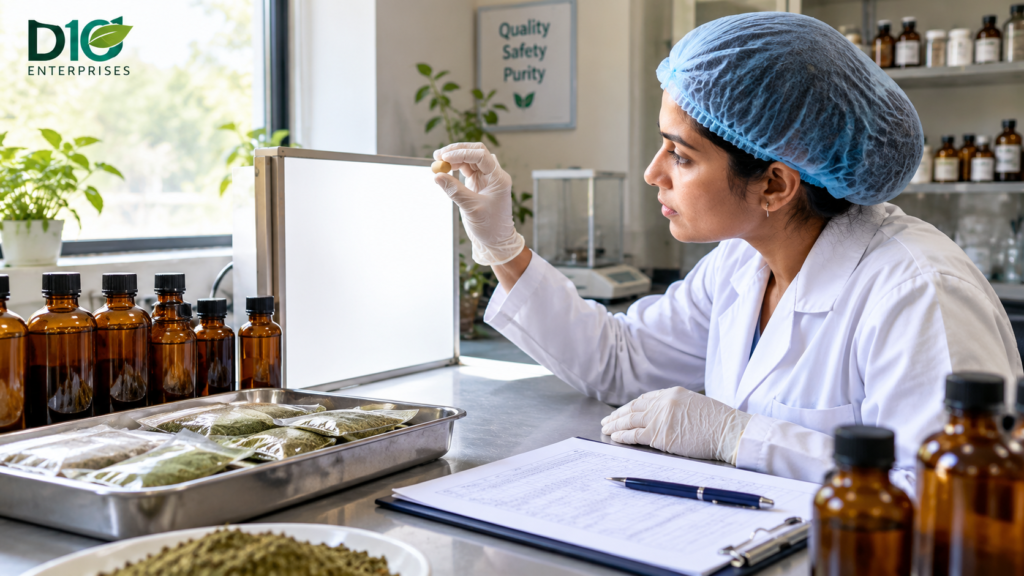
A proper contract medicine producer for herbal products generally offers more than just filling bottles. Look for formulation support from people who actually understand herbal actives and their interactions, batch testing before release, proper documentation you can show a retailer or distributor, and packaging that protects a tonic or powder through transport and storage.
D10 describes its offer as GMP standard production with quality control, alongside custom formulation solutions, private branding and labeling, regulatory operations and support, and a quality, safety and compliance programme. As with any manufacturer, ask to see actual documentation behind these claims rather than relying on the website description alone.
White Label Versus Custom Herbal Formulation
White label ayurvedic manufacturing means picking a formula that already exists in the manufacturer’s range and putting your brand on it. It is the faster, cheaper way to start, and it works well if your target formula, say a standard ashwagandha tonic or a triphala powder, is fairly established and does not need much adjustment.
Custom formulation is a longer process where the manufacturer’s team develops or adjusts a formula around your brief. This matters more for herbal products than people expect, because taste, colour and shelf stability can vary a lot between batches of raw botanical material. A manufacturer with real formulation experience will test for this rather than assume the first batch behaves the same as the tenth.
D10’s earlier catalogue material for cosmetics and herbal products has included branded formulation lines, which suggests the company works across multiple established herbal product ranges rather than a single generic base. If a specific existing formula interests you, ask directly whether it is available for private label.
How the Process Typically Works
Most herbal contract manufacturing projects follow a similar sequence. You share a brief covering the product type, key herbs or actives, expected claims and rough order size. The manufacturer proposes a formula, and this is usually where herbal products need an extra round or two of sampling, since natural ingredients vary batch to batch. Once you approve a sample, packaging and label artwork get finalised, production runs in batches under the applicable licence, and the batch is tested before release and dispatch.
For a Kolkata based brand, ask specifically how the manufacturer accounts for natural variation in herbal raw material, and what stability testing they run before a formula is considered final. This one detail separates a serious herbal manufacturer from one simply filling bottles.
Supplement Contract Services: What to Compare
When you are comparing supplement contract services from different manufacturers, a short table helps keep the comparison honest.
| Point to check | Why it matters |
|---|---|
| Valid AYUSH licence for your product category | Legal requirement, not optional |
| Experience with herbal raw material variation | Affects consistency batch to batch |
| Minimum order quantity | Decides your upfront cost |
| Sample and revision process | Shows how flexible the formulation team is |
| Packaging suited to herbal products | Protects shelf life and appearance |
| Batch documentation | Needed for retailers and your own records |
| Dispatch time to Kolkata | Affects your launch and restocking plans |
What Affects the Cost
Herbal formulation costs depend heavily on the raw material itself, since botanical ingredients vary in price by season and source. Beyond that, batch size, packaging type, whether the product needs extraction or just blending, testing, and freight all play a part. A tonic in a glass bottle with a printed carton costs differently from a powder in a simple pouch, so ask for a cost breakdown by stage rather than a single bundled number.
Common Mistakes to Avoid
The most frequent mistake is assuming all herbal manufacturers hold the same type of licence, when in fact many food supplement makers do not hold an AYUSH licence at all. If your product carries therapeutic claims, this distinction matters a great deal. Another common issue is skipping stability testing, which shows up later as colour change, separation or reduced potency on the shelf. A third mistake is rushing the label, since herbal and Ayurvedic products often need specific claim language checked carefully before printing.
Starting the Conversation
Before reaching out to any manufacturer, put together a short brief: the product type, key herbs or actives you want, any claims you plan to make, your expected first order, and your target launch date. This lets a manufacturer tell you honestly and quickly whether your project is something they can take on.
To speak with D10 Enterprises, start with their about page, then reach them through the contact page, by phone on +91-7988374621, or by email at d10enterprisesambala@gmail.com. Their address is 226/2 and 226/3, Ajit Nagar, Ambala Cantt, Haryana 133001. You can also browse their product catalog or start from the D10 Enterprises homepage.
Frequently Asked Questions
Is there a D10 facility in Kolkata?
No. D10 Enterprises is based in Ambala Cantt, Haryana, and works with brand owners in other cities remotely.
What licence does a herbal or Ayurvedic manufacturer need?
An AYUSH manufacturing licence, or an AYUSH loan licence if the brand wants to hold its own licence while using the manufacturer’s facility.
What is the difference between a manufacturing licence and a loan licence?
A manufacturing licence is held by the factory itself. A loan licence lets a brand hold its own licence while producing at an already licensed third party’s premises.
Can I put my own brand on an existing formula?
Yes, this is what white label ayurvedic manufacturing means, and D10 lists private branding and labeling as a service.
Do herbal products need different testing than regular supplements?
Yes, generally more attention to stability, since natural raw material varies batch to batch in ways synthetic ingredients usually do not.
What should I prepare before contacting a manufacturer?
A short brief covering your product type, key ingredients, intended claims, order size and launch timeline.