Gummies have become one of the fastest growing supplement formats in India, and it is not hard to see why. Nobody enjoys swallowing a bitter capsule when a chewable vitamin tastes like a sweet instead. If you are building a wellness or fitness brand out of Bangalore and looking for a gummy third party manufacturer, you are likely weighing taste, texture and dosage accuracy against cost, since gummies are genuinely a more technical product to produce consistently than a simple tablet or capsule.
This guide explains how gummy third party manufacturer bangalore, what makes gummies different from other supplement formats to produce, what to check before signing with a factory, and where D10 Enterprises fits if you are running your brand from Bangalore and manufacturing elsewhere.
Why Bangalore Brands Manufacture Gummies Outside the City
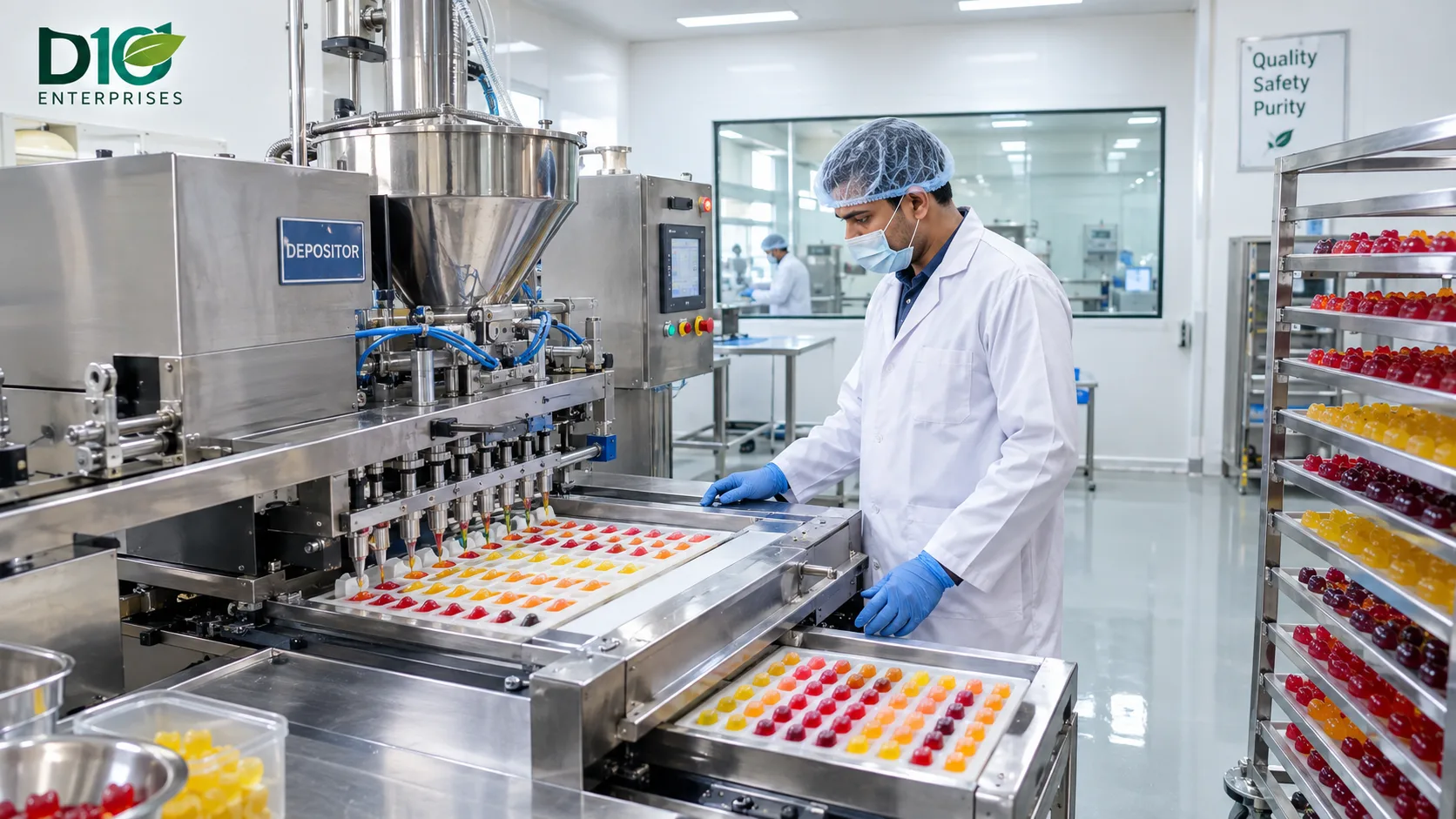
Bangalore has a large, young, health conscious population, a strong D2C ecosystem and no shortage of fitness and wellness influencers willing to talk about a good gummy brand. What it does not have in easy supply is the kind of industrial space gummy production needs, since a proper gummy line involves cooking vessels, starch moulding or silicone moulding equipment, depositing machines and controlled drying areas, none of which fit easily into a small urban unit.
Because of that, most Bangalore gummy brands run their marketing and sales locally while manufacturing happens elsewhere. D10 Enterprises, based at Ajit Nagar, Ambala Cantt, Haryana, is one such manufacturer, working across nutraceuticals, cosmetics, dermatology and herbal products. It has no Bangalore facility, and what actually decides whether the relationship works for you is sample quality, communication and reliable dispatch rather than physical distance.
Why Gummies Are Harder to Manufacture Than They Look
A gummy third party manufacturer needs to get several things right at once that a capsule or tablet manufacturer does not have to think about in the same way. The gelling agent, usually gelatin or a plant based pectin for vegetarian gummies, has to set consistently across every batch. The active ingredient needs to survive the heat used during cooking without losing potency, which rules out some vitamins unless the process is adjusted carefully. Flavour and colour need to mask what are often naturally bitter actives like zinc or iron. And dosage accuracy matters just as much in a gummy as in a capsule, even though it looks and feels like a sweet.
This is why it is worth asking any gummy third party manufacturer, D10 included, whether they have actually produced gummies with your specific active ingredient before, rather than assuming a generic multivitamin gummy process will transfer smoothly to something like melatonin, collagen or a probiotic blend.
What D10 Enterprises Offers for Gummy Manufacturing
D10 Enterprises manufactures gummies as part of its nutraceutical production, alongside its listed formats of syrup, softgel capsules, protein powders and mouth spray, which you can see on the nutraceuticals manufacturing page. Beyond the format itself, the company offers the surrounding services that matter for a custom gummy project, custom formulation solutions for developing a specific flavour and active combination, private branding and labeling so the finished jar carries your brand, and a quality, safety and compliance programme covering batch testing. The broader product catalog shows the wider manufacturing range.
White Label Gummy Services Versus Custom Formulation
White label gummy services mean picking an existing gummy formula, say a standard multivitamin or vitamin C gummy, and putting your brand on it. This is the quicker and more affordable route, with lower minimum order quantities and no development time, and it suits founders who want to launch fast with a proven, familiar product.
Custom gummy contract manufacturing goes further, building a formula around your specific brief, a particular active combination, a sugar free version, or a flavour profile tailored to Indian taste preferences. It takes longer and usually needs more sample rounds, since flavour masking for actives like zinc or ashwagandha genuinely is harder to get right than people expect on the first try. D10 lists both routes separately, so you can start with white label and move to custom formulation once you know what your customers respond to.
The Licence Side of Gummy Manufacturing
Gummies fall under the health supplement and nutraceutical category for regulatory purposes, which means FSSAI licensing applies rather than cosmetic or drug rules. Health supplement and nutraceutical manufacturing sits in FSSAI’s mandatory Central License category, regardless of the manufacturer’s turnover, unlike many ordinary food businesses where licence type depends on sales volume. Before committing to any gummy manufacturer, ask to see their Central FSSAI licence and confirm it specifically covers nutraceutical or health supplement manufacturing.
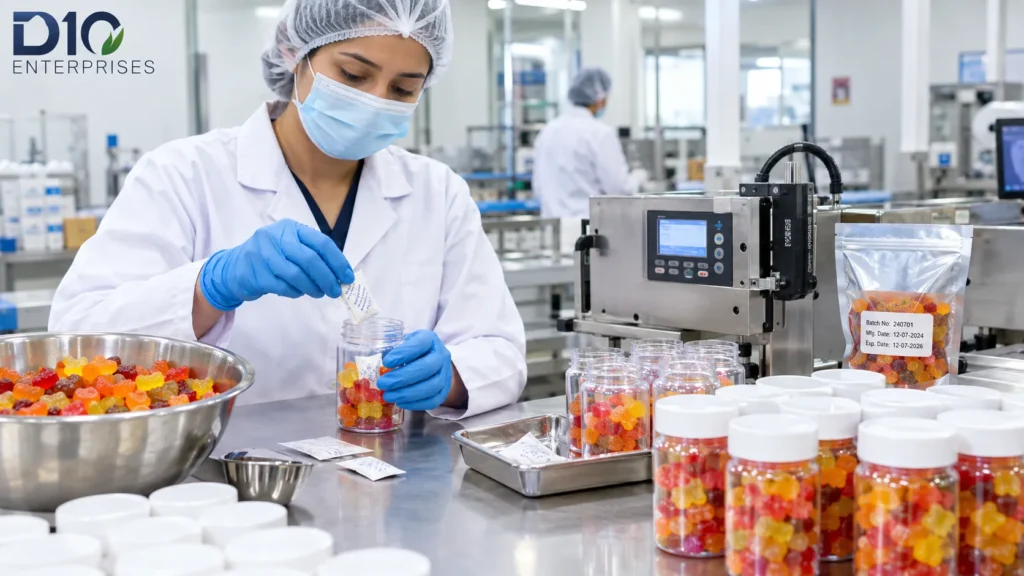
Labelling also needs attention. A gummy supplement label should carry accurate dosage information, the FSSAI licence number, batch number and expiry date, along with a clear ingredient list, since gummies are easy for a customer to mistake for candy if the labelling does not make the dosage obvious. D10 lists regulatory operations and support as a service worth raising early in your conversation.
How the Manufacturing Process Usually Works
Most gummy projects follow a fairly similar sequence. You share a brief covering the active ingredient, target flavour, sugar or sugar free preference, shape and expected first order size. The manufacturer proposes a formula and sends samples, and this stage for gummies often needs two or three rounds of adjustment, since taste and texture are genuinely harder to get right than with a capsule or tablet. Once a sample is approved, packaging gets finalised, label artwork is checked against dosage and compliance requirements, production runs in batches, and the batch is tested before dispatch.
For a Bangalore based brand, it is worth asking specifically how the manufacturer packages gummies for transit, since heat and humidity during freight can affect texture if packaging is not suited to the climate along the route.
Questions to Ask a Contract Supplement Producer
- Have you manufactured gummies with this specific active ingredient before?
- Do you hold a Central FSSAI licence covering nutraceutical and health supplement manufacturing?
- What gelling agent do you use, and do you offer a vegetarian or pectin based option?
- What is the minimum order quantity for a first gummy batch?
- How many sample rounds are typically included before a formula is approved?
- Do you provide a certificate of analysis confirming dosage accuracy per gummy?
- What packaging do you recommend to protect texture during shipping to Bangalore?
What Shapes the Cost of a Gummy Batch
Gummy pricing depends on several factors that are worth understanding before you ask for a quote. The active ingredient and its concentration matter most, since some actives cost significantly more than others. The gelling agent choice affects cost too, with pectin based vegetarian gummies often priced above standard gelatin ones. Flavouring and colouring, especially natural options, add to the cost compared to synthetic alternatives. Batch size changes the per-unit price meaningfully, and packaging, whether a simple pouch or a child resistant jar, plays a real role as well. Ask for a cost breakdown across formulation, production, packaging, labelling and testing rather than accepting a single bundled figure.
Common Mistakes Brands Make With Gummies
The most frequent mistake is assuming any supplement manufacturer can produce gummies well, when gummy production genuinely is a different skill set from tablets or capsules. Another is approving a sample based on taste alone without confirming dosage accuracy across the batch, which matters for actives like melatonin or vitamin D where consistency genuinely affects the product’s effectiveness. A third is underestimating how long flavour development can take, especially for actives that are naturally bitter or metallic tasting.
Getting Started
Before reaching out to a manufacturer, put together a short brief: your target active ingredient, dosage, flavour preference, sugar or sugar free direction, expected first order and launch timeline. This lets a manufacturer, D10 included, give you an honest answer about whether they can deliver what you are picturing.
To speak with D10 Enterprises, start with their about page, then reach them through the contact page, by phone on +91-7988374621, or by email at d10enterprisesambala@gmail.com. Their address is 226/2 and 226/3, Ajit Nagar, Ambala Cantt, Haryana 133001. You can also start from the D10 Enterprises homepage.
Frequently Asked Questions
Does D10 have a facility in Bangalore?
No. D10 Enterprises is based in Ambala Cantt, Haryana, and works with Bangalore based brand owners remotely.
Does D10 Enterprises actually manufacture gummies?
Yes, gummies are part of their nutraceutical manufacturing range.
What licence should a gummy manufacturer hold?
A Central FSSAI licence covering nutraceutical and health supplement manufacturing, which is mandatory for this category regardless of turnover.
Is white label gummy manufacturing cheaper than custom formulation?
Usually yes, since there is no formula development time and minimum orders tend to be lower.
Can I launch under my own brand name?
Yes, private branding and labeling is listed as a service on D10’s website.
Why do gummies often need more sample rounds than capsules?
Because taste, texture and dosage accuracy all have to work together, and naturally bitter actives need careful flavour masking to get right.