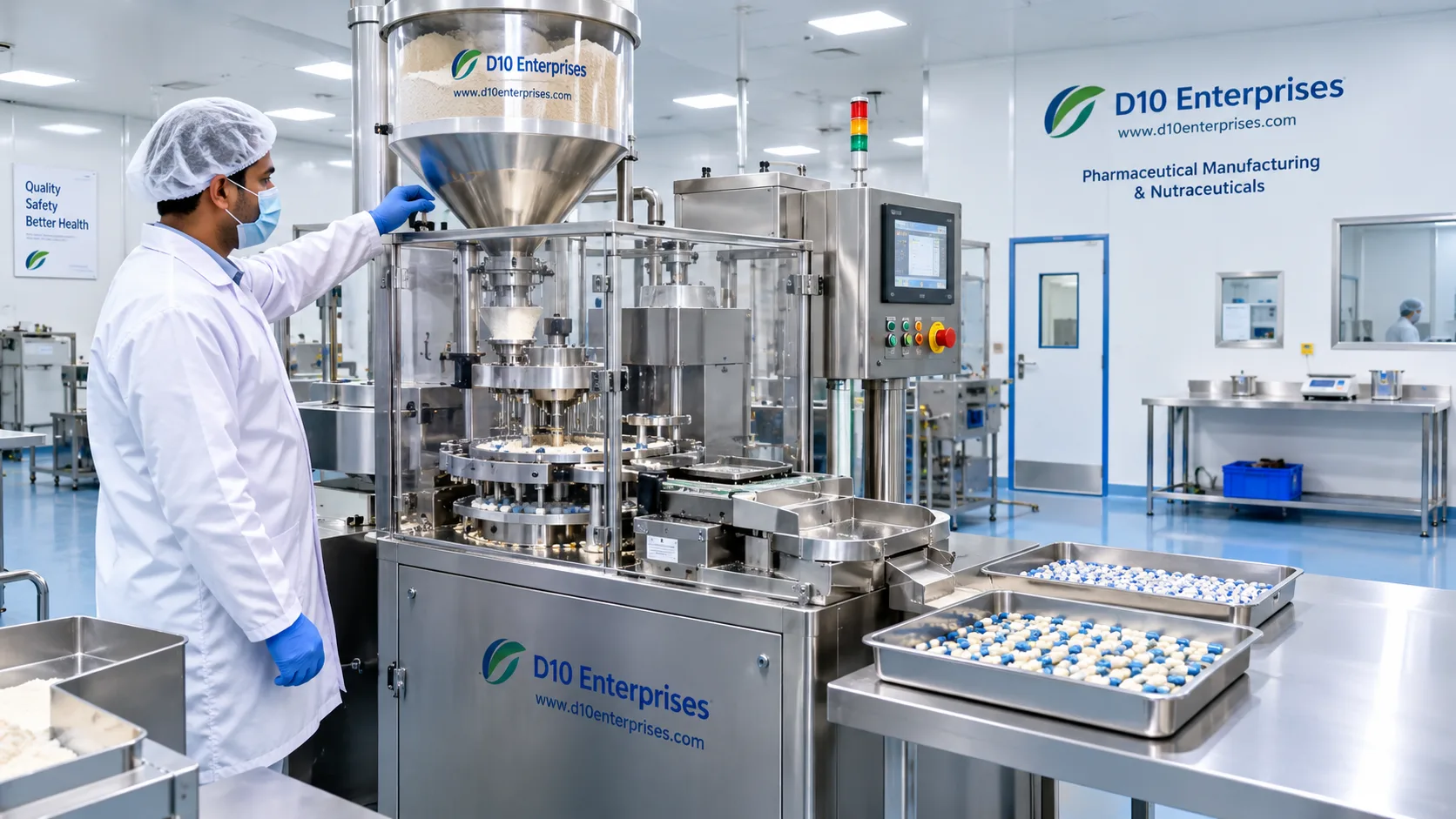
Vitamin capsules look simple from the outside, a powder or oil blend inside a small shell, but getting a batch made affordably without cutting corners on quality is harder than most first-time founders expect. If you are building a wellness brand in Mumbai and searching for a vitamin capsule third party manufacturer mumbai, you are probably weighing two things against each other, keeping your per-unit cost low enough to price competitively, and not ending up with a factory that skips testing to hit that price.
This guide explains how capsule contract manufacturing actually works, what genuinely affects cost, the one licence requirement that catches many new brands off guard, and where D10 Enterprises fits if you are running your brand from Mumbai but manufacturing elsewhere.
Why Mumbai Brands Manufacture Outside Mumbai
Mumbai has a dense, engaged wellness market and no shortage of people willing to try a new vitamin brand. What it lacks is affordable industrial space suited to capsule filling and powder handling at scale. Real estate costs inside the city push most production to nearby industrial states, which is a large part of why “affordable” and “Mumbai factory” rarely appear in the same sentence.
D10 Enterprises, based in Ajit Nagar, Ambala Cantt, Haryana, is one of the manufacturers Mumbai founders work with remotely. It has no Mumbai facility. What decides whether this kind of arrangement actually works for you is sample quality, communication and how predictably stock reaches you, not the city on the manufacturer’s address.
The Licence Rule Most New Brands Miss
Here is something worth knowing before you shortlist anyone. Health supplements and nutraceuticals, which is the category vitamin capsules fall under, sit in FSSAI’s list of businesses that require a mandatory Central License, regardless of annual turnover. This is different from most ordinary food businesses, where the licence type depends on how much you sell. A manufacturer of vitamin capsules is expected to hold a Central FSSAI licence from the start, not work up to one as turnover grows.
This matters directly when you are choosing a contract manufacturer. Ask to see their Central FSSAI licence and confirm it covers the specific product category, capsules in particular, rather than accepting a general food licence as proof. A factory that only holds a Basic Registration or State License is not properly set up to manufacture health supplements under the rules.
D10 lists regulatory operations and support as part of its service range. It is reasonable to ask directly which licence category they operate under before sending any formulation brief.
What D10 Lists Under Nutraceuticals
According to its website, D10 Enterprises groups its nutraceutical manufacturing into syrup, softgel capsules, protein powders and mouth spray. You can see this on the nutraceuticals manufacturing page and the broader product catalog. Softgel capsules, specifically, are the relevant format for oil based vitamins like D3, E or omega blends, and they use a different production process from dry powder-filled capsules, so it is worth confirming with any manufacturer whether your formula needs a softgel shell or a standard two-piece capsule, since not every facility runs both lines.
What Actually Makes Capsule Manufacturing Affordable or Not
Affordable manufacturing does not mean the cheapest quote you can find. It means getting a fair price for what you are actually ordering, without hidden gaps in quality. A few things genuinely move the cost of a capsule batch.
The active ingredient and its form matter most, a synthetic vitamin blend costs differently from a natural or organic sourced one. Capsule shell type matters too, standard gelatin shells are cheaper than vegetarian HPMC shells, which more health conscious buyers now expect. Batch size has a big effect, since larger runs spread fixed costs like machine setup across more units. Packaging choice, bottle versus blister strip versus pouch, changes cost meaningfully, and so does the testing your manufacturer runs before release.
Ask for a breakdown by stage, formulation, capsule filling, packaging, labelling and testing, rather than one bundled number. This single habit makes it far easier to spot where a suspiciously low quote might be cutting a corner.
White Label Vitamin Services Versus Custom Formulation
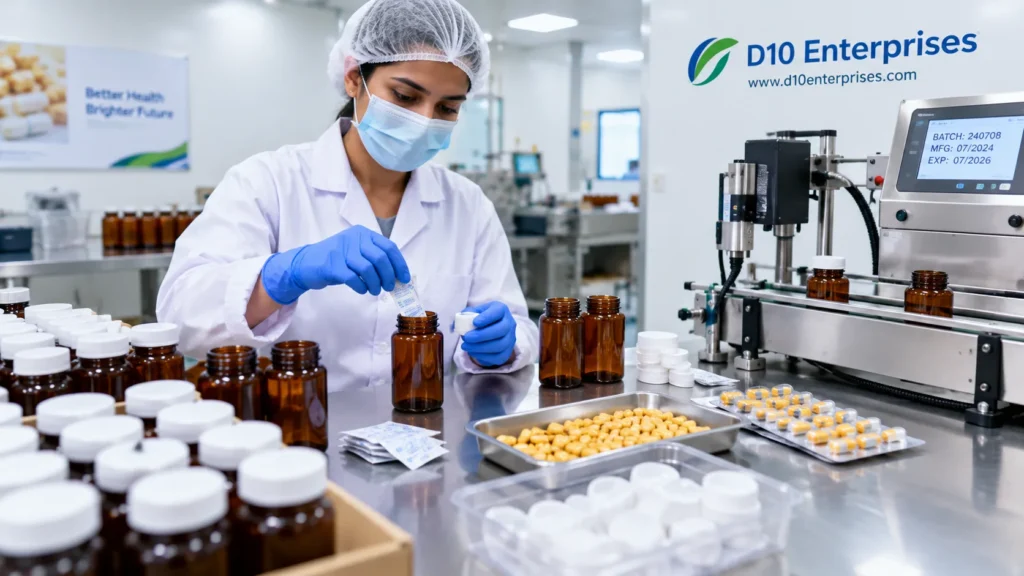
White label vitamin services mean choosing a formula that already exists in the manufacturer’s range and putting your label on it. This is usually the more affordable starting point, since there is no development cost and minimum orders tend to be lower. It suits founders launching a fairly standard product, a basic multivitamin or a vitamin C capsule, where differentiation will come from branding and marketing rather than formula.
Custom formulation means building or adjusting a blend around your specific brief, perhaps a particular combination of vitamins and minerals, or a dosage not commonly available off the shelf. It costs more and takes longer, but gives you a genuinely different product. D10 lists both custom formulation solutions and private branding and labeling separately, so you can start with whichever suits your budget and move to the other later as the brand grows.
How the Process Typically Works
Most capsule manufacturing projects follow a similar sequence. You share a brief covering the vitamin or vitamin blend, target dosage, shell preference and expected first order size. The manufacturer proposes a formula and sends samples for approval. Once you sign off, packaging and label artwork get finalised, production runs in GMP batches, and the batch is tested before release and dispatched to you.
For a Mumbai based brand, ask specifically about dispatch timelines and how the manufacturer packs stock for transit, since capsules can be sensitive to heat and humidity during longer freight routes.
Questions Worth Asking Before You Commit
- Do you hold a Central FSSAI licence covering health supplements and capsules specifically?
- Have you manufactured this exact vitamin formula or a close equivalent before?
- What shell type do you offer, gelatin or vegetarian HPMC, and does cost differ between them?
- What is the minimum order quantity for a first batch?
- Do you provide a certificate of analysis with each batch?
- How is the price broken down across formulation, filling, packaging and testing?
- What is the typical time from sample approval to dispatch?
Common Mistakes First-Time Founders Make
The most common mistake is choosing the lowest quote without checking the Central FSSAI licence requirement, since that single oversight can create real compliance problems later. Another is ordering a large first batch to get a better per-unit price, before confirming the market actually wants that exact formula. A third is skipping the certificate of analysis step, which is your evidence of quality if a retailer or marketplace ever asks for it.
Getting Started
Before contacting a manufacturer, put together a short brief: the vitamin or blend you want, dosage, shell preference, expected first order and your target launch date. This lets a manufacturer give you a realistic, honest quote rather than a generic one.
To speak with D10 Enterprises, start with their about page, then reach them through the contact page, by phone on +91-7988374621, or by email at d10enterprisesambala@gmail.com. Their address is 226/2 and 226/3, Ajit Nagar, Ambala Cantt, Haryana 133001. You can also start from the D10 Enterprises homepage.
Frequently Asked Questions
Does D10 have a facility in Mumbai?
No. D10 Enterprises is based in Ambala Cantt, Haryana, and works with Mumbai based brand owners remotely.
Do vitamin capsule manufacturers need a special FSSAI licence?
Yes. Health supplement and nutraceutical manufacturing is a mandatory Central FSSAI License category, regardless of the business’s turnover.
What is the difference between gelatin and vegetarian capsule shells?
Gelatin shells are generally cheaper, while vegetarian HPMC shells cost more but suit brands targeting vegetarian or vegan customers.
Is white label manufacturing cheaper than custom formulation?
Usually yes, since there is no formula development cost and minimum orders tend to be lower.
Can I put my own brand name on the bottle?
Yes, private branding and labeling is listed as a service on D10’s website.
What should I ask for before approving a quote?
A cost breakdown by stage, formulation, filling, packaging, labelling and testing, rather than a single bundled price.