Derma cosmetics sit in an odd spot. They are sold next to regular skincare, often recommended by dermatologists, and marketed with language that sounds almost medical, barrier repair, pigmentation correction, acne control. But in India, a derma cosmetic is still legally a cosmetic, not a drug, unless the claims on its label cross a specific line. If you are building a derma brand from Delhi, understanding that line matters just as much as finding a factory that can produce the cream itself.
This guide covers how derma cosmetics contract manufacturing actually works, where the legal boundary between cosmetic and drug sits, what to check before choosing a manufacturer, and where D10 Enterprises fits for a Delhi based brand Derma Cosmetics Third Party Manufacturer Delhi.
Why Delhi Brands Manufacture Outside the City
Much like regular skincare and nutraceuticals, derma cosmetics are rarely produced inside Delhi itself. Industrial land, water requirements for emulsification and the equipment needed for stable cream and serum production tend to sit in nearby industrial belts instead, places like Ambala in Haryana, well connected to Delhi NCR by road.
D10 Enterprises operates from Ajit Nagar, Ambala Cantt, Haryana, and works as a third party manufacturer for dermatology and cosmetic products. It does not have a Delhi facility. For a brand owner, what decides whether the arrangement works smoothly is less about distance and more about communication, sample quality and dispatch reliability.
Cosmetic or Drug: The Line You Cannot Ignore
This is the part of derma cosmetics that catches new founders off guard. In India, cosmetics are regulated under the Drugs and Cosmetics Act, 1940 and the Cosmetics Rules, 2020, while drugs follow a separate and much stricter pathway requiring clinical data. A product stays a cosmetic as long as its claims stay cosmetic in nature, things like evening out skin tone or reducing the appearance of blemishes. The moment a label says something like “treats acne” or “repairs the skin barrier,” it can tip the product into drug classification, which brings a far more demanding approval process.
A few categories are treated as exceptions and sit under drug rules even when sold like cosmetics, medicated shampoo and acne creams are commonly cited examples. The practical takeaway for a Delhi brand owner is simple. Decide early, with your manufacturer’s regulatory team, whether your product and its marketing claims are meant to stay cosmetic or move toward a therapeutic positioning, because this decision shapes your licensing path, your label wording and your manufacturing timeline.
D10 lists regulatory operations and support as a service, which is worth raising early in any conversation, specifically asking how they help brands keep claims within cosmetic boundaries or guide them toward the correct licence if a drug classification applies.
What Contract Skincare Producer Services Should Cover
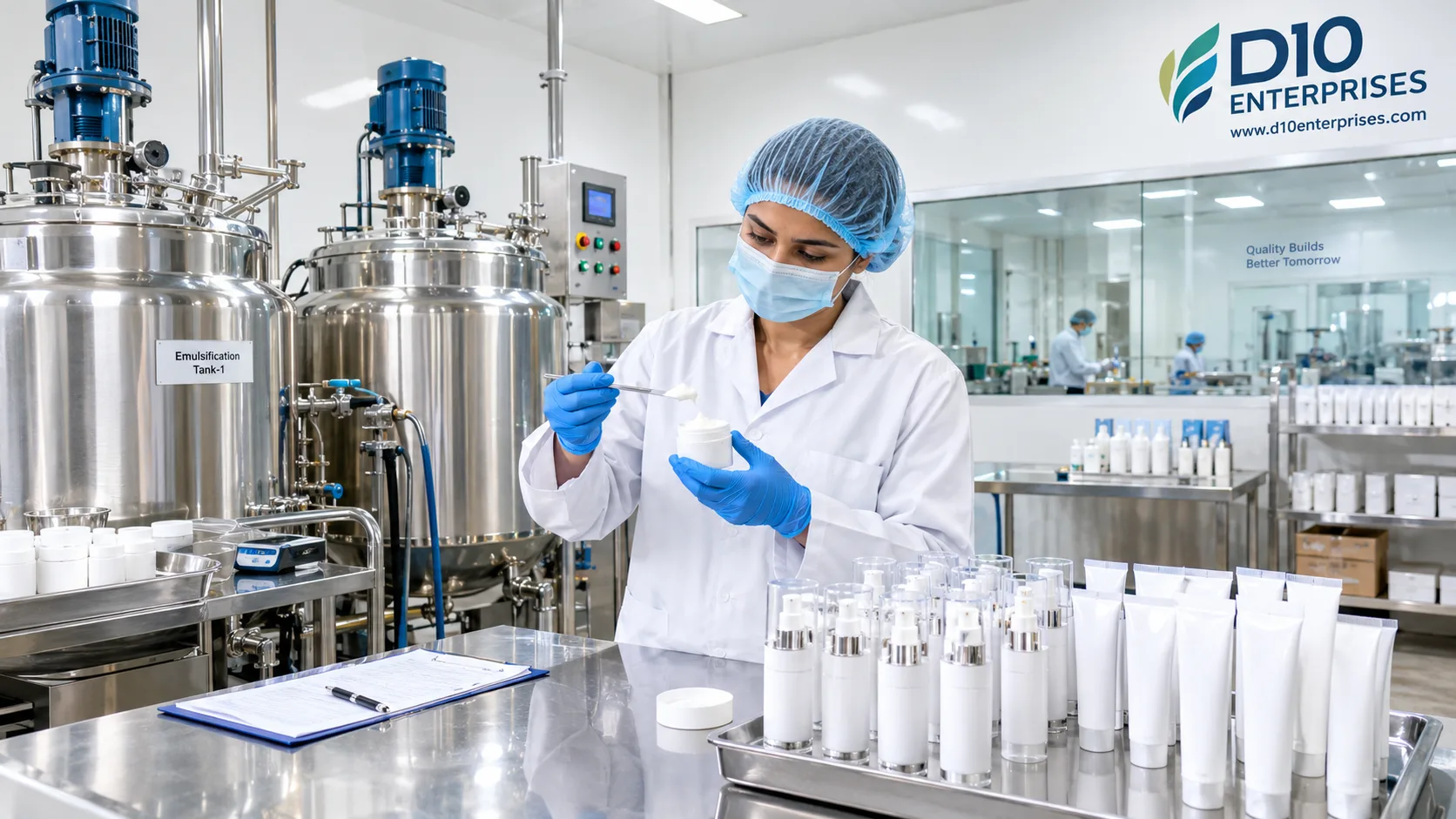
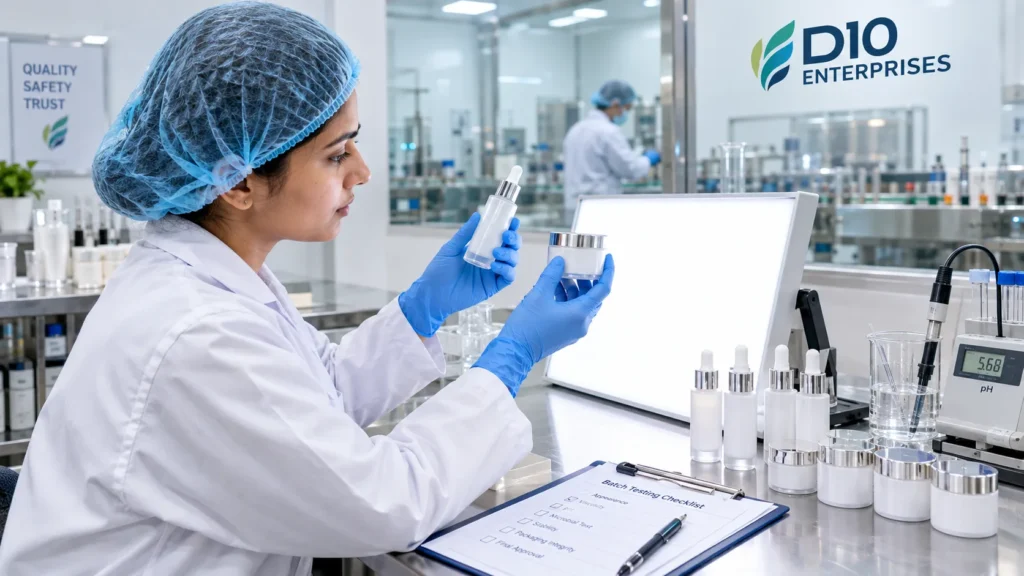
A genuine contract skincare producer offers more than just filling jars. Look for GMP standard production with documented quality checks, a formulation team that understands actives relevant to derma cosmetics like niacinamide, salicylic acid or ceramides, private labeling so the finished product carries your brand, and clear batch records you can show a retailer or dermatologist partner.
D10 describes its own offer along these lines, GMP pharmaceutical manufacturing, custom formulation solutions, private branding and labeling, loan licensing services, and a quality, safety and compliance programme. As always, ask to see documentation behind these claims rather than taking the website description at face value.
Product Categories D10 Lists for Derma and Cosmetics
According to its site, D10 Enterprises separates its cosmetics offering into a few distinct lines relevant to derma focused brands. The derma cosmetics category sits alongside serum, cream, face scrub, face wash, organic cosmetics and colour cosmetics. For a Delhi founder planning a focused launch, say a serum and a complementary cream, having one manufacturer that covers both formats under the same facility simplifies formulation consistency and reduces the number of vendors you need to manage. The full range can be seen on the product catalog.
White Label Dermatology Products Versus Custom Formulation
White label dermatology products are an existing formula from the manufacturer’s range that you put your brand name on. It is the quicker, lower cost way to enter the category, and it suits founders who want to launch with a proven formula rather than spend months in development.
Custom formulation means the manufacturer’s chemists build or adjust a product specifically for your brief, whether that is a particular active ingredient concentration, a texture suited to Delhi’s dry winters and humid summers, or a fragrance-free version for sensitive skin. It takes longer and usually needs a higher minimum order, but gives you a more differentiated product.
Ask any manufacturer, D10 included, how many rounds of sample revision are included before you are expected to approve a formula, since this affects both your timeline and your budget.
Loan Licensing for Derma Cosmetics
For brands that want more regulatory ownership, loan licensing is worth understanding. Under this arrangement, you hold the manufacturing licence yourself while producing at an already licensed third party facility, rather than simply buying finished goods under the factory’s own licence. D10 lists loan licensing services as a separate offering from standard contract manufacturing, useful if you eventually want closer control over your regulatory filings, particularly relevant if your derma cosmetic later moves toward higher active concentrations that invite more scrutiny.
How the Manufacturing Process Typically Runs
The sequence is fairly standard across most derma cosmetics manufacturers. You share a brief covering skin concern, target actives, texture preference and expected order size. The manufacturer proposes a formulation and shares samples, often needing a round or two of adjustment, especially for actives that are sensitive to pH or stability. Once approved, packaging and label artwork get finalised, with claims checked against the cosmetic versus drug line discussed earlier. Production runs in GMP batches, gets tested, and is dispatched to you.
For a Delhi based brand, ask specifically how stability testing is handled for actives that degrade in heat or light, since this affects both shelf life and how you store and transport stock within Delhi NCR.
A Quick Comparison Checklist
| Point to check | Why it matters |
|---|---|
| Valid cosmetic manufacturing licence | Legally required to produce and sell |
| Clarity on cosmetic versus drug claims | Avoids label and compliance issues later |
| Experience with your specific product type | Reduces risk of a first-attempt batch |
| Minimum order quantity | Affects your launch budget |
| Stability and batch testing | Confirms product holds up over shelf life |
| Packaging suited to actives used | Some ingredients need airless or opaque packaging |
| Dispatch time to Delhi NCR | Impacts your launch and restocking schedule |
What Shapes the Cost
Several things affect pricing for derma cosmetics manufacturing: the specific actives and their concentration, batch size, packaging type (airless pumps generally cost more than simple jars), label printing, stability testing, and freight. Ask for a cost breakdown by stage, formulation, filling, packaging, labelling and testing, rather than accepting a single bundled figure, so you can see exactly where your budget is going.
Common Mistakes to Avoid
The biggest one is marketing language drifting into drug territory without the founder realising it, a label that promises to “treat” a skin condition rather than “improve its appearance” can create compliance problems later. Another mistake is skipping stability testing on sensitive actives, which shows up as separation or loss of potency after a few months on the shelf. A third is choosing a manufacturer purely on price without confirming they hold a valid licence for the specific product category you want.
Getting Started
Before reaching out to any manufacturer, prepare a short brief: your target skin concern, preferred actives, texture, intended claims, expected first order and launch date. This helps a manufacturer give you an honest answer quickly rather than a generic quote.
To speak with D10 Enterprises, start with their about page, then reach them through the contact page, by phone on +91-7988374621, or by email at d10enterprisesambala@gmail.com. Their address is 226/2 and 226/3, Ajit Nagar, Ambala Cantt, Haryana 133001. You can also start from the D10 Enterprises homepage.
Frequently Asked Questions
Does D10 have a facility in Delhi?
No. D10 Enterprises is based in Ambala Cantt, Haryana, and works with Delhi based brands remotely.
What is the difference between a derma cosmetic and a cosmeceutical?
In practice, the terms are often used interchangeably. Legally, both are treated as cosmetics in India as long as their claims stay cosmetic rather than therapeutic.
When does a derma cosmetic become a drug under Indian law?
When its claims describe treating a medical condition, such as acne or pigmentation disorders, rather than improving appearance.
Can I launch under my own brand name?
Yes. Private branding and labeling is listed as a service on D10’s website.
What is loan licensing and do I need it?
It lets you hold your own manufacturing licence while using a third party’s licensed facility. Most new brands start with standard contract manufacturing and consider loan licensing later.
What should I prepare before contacting a manufacturer?
A brief covering your target skin concern, preferred actives, texture, intended label claims, order size and launch timeline.