If you run a nutraceutical manufacturer delhi Delhi or you’re planning to launch one, you’ve probably already searched for a nutraceutical manufacturer in Delhi and found the same problem everyone else does. Most listings are directories, not real manufacturers. A few are agents who outsource your order to a factory two states away without telling you. And the genuinely GMP-certified units that can actually produce softgels, syrups or protein powders at scale are rarely sitting inside the city itself, they’re usually in the industrial belts around Haryana, Himachal or Uttarakhand where land, water and pollution norms make large scale pharma production practical.
That’s not a knock against Delhi based brands. It just means the smarter question isn’t “who manufactures in Delhi” but “who can manufacture reliably for a Delhi brand, ship on time, and let me put my label on the bottle.” This article walks through what third party nutraceutical manufacturing actually involves, what to check before signing with anyone, and where a manufacturer like D10 Enterprises fits into that picture.
Why Most Delhi Brands Manufacture Outside the City
Delhi NCR has become one of India’s biggest hubs for wellness, fitness and health supplement brands, but very little of that product is actually made inside Delhi’s municipal limits. Zoning restrictions, high real estate costs and stricter emission norms push pharmaceutical and nutraceutical production out to nearby industrial towns. Ambala Cantt in Haryana, roughly a four to five hour drive from Delhi, is one of these belts. It has an established base of pharma and cosmetic manufacturing units, decent road connectivity via NH44, and lower overheads than setting up inside the capital.
For a brand owner, this means your actual manufacturing partner is almost never going to be a Delhi address. What matters more is whether they’re GMP compliant, whether they can handle your specific product format, and whether their logistics actually work for a Delhi based business.
What a Third Party nutraceutical manufacturer delhi Should Offer
Before you shortlist anyone, it helps to know what a complete third party manufacturing setup should cover. A serious manufacturer generally offers:
- End to end GMP standard production with documented quality control at every stage
- Custom formulation support, so you’re not stuck picking from a fixed catalog
- Private branding and labeling, meaning the finished product carries your brand, not theirs
- Loan licensing options if you want to manufacture under your own license using their infrastructure
- Regulatory support to help with the compliance paperwork that Indian nutraceutical products require
- Clear quality, safety and batch documentation you can show retailers or e-commerce platforms
D10 Enterprises, based in Ambala Cantt, Haryana, structures its services around exactly these points. Its manufacturing division covers GMP pharmaceutical manufacturing, and the company separately lists custom formulation solutions, private branding and labeling, loan licensing services, regulatory operations and support, and a dedicated quality, safety and compliance program, all of which you can review directly on their site.
Product Formats: What Can Actually Be Manufactured
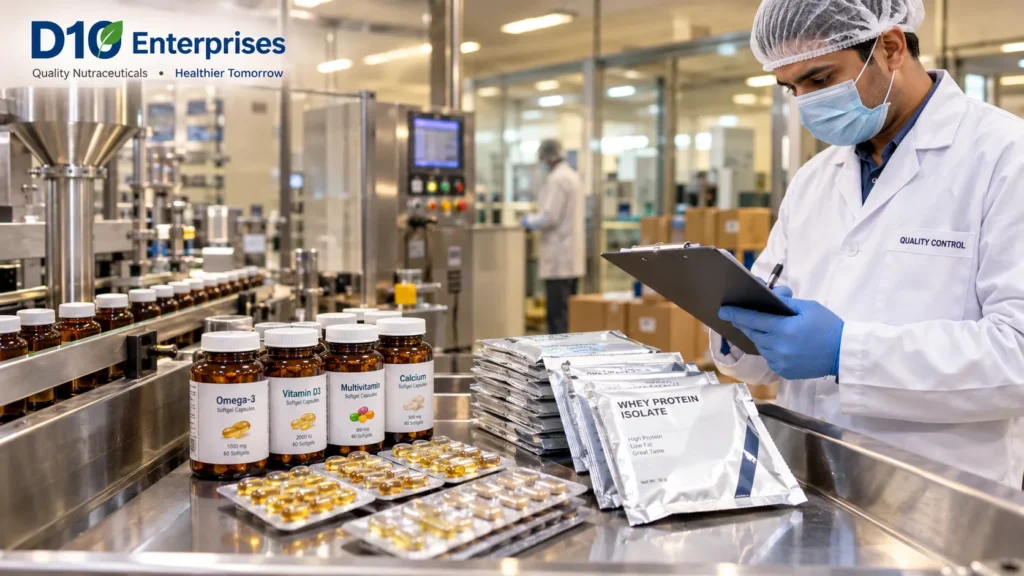
One of the first things a Delhi based brand needs to check is whether a manufacturer can actually produce the specific format they’re planning to sell. Nutraceutical products aren’t one thing, they span several very different production processes. D10’s own product listing under its nutraceuticals manufacturing page groups its capabilities into four broad categories:
Syrups are liquid formulations, typically used for vitamin, mineral or tonic based supplements aimed at daily consumption. Production requires proper mixing, filtration and bottling lines with contamination controls specific to liquids.
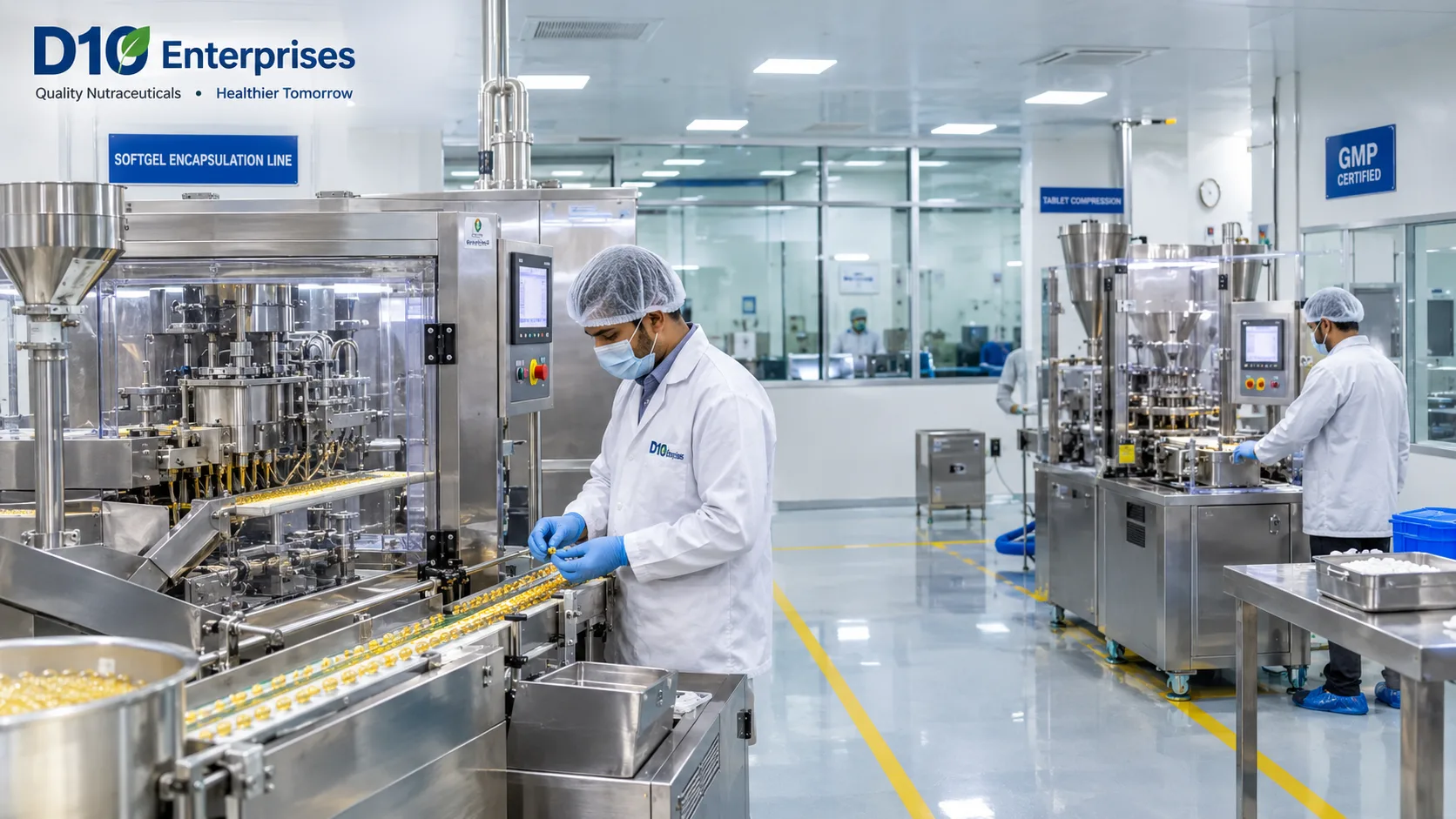
Softgel capsules cover oil based actives like omega 3s, vitamin E or herbal extracts sealed inside a gelatin shell. This is a more technical process than tablet manufacturing and not every facility runs a softgel encapsulation line.
Protein powders are dry blend products, usually whey, plant protein or specialty blends, that need accurate dosing, flavor masking and moisture control during packing to avoid clumping or spoilage.
Mouth spray formats are a more niche category, often used for vitamin B12, melatonin or quick absorption supplements, and require fine misting equipment and careful stability testing.
If you’re a Delhi brand planning a specific product, the practical first question to ask any manufacturer, D10 included, is simply whether they currently run that exact production line, and whether they can share sample batches before you commit to a full production run.
How the Manufacturing Process Usually Works
Third party manufacturing generally follows a fairly standard sequence, whether you’re working with a unit in Haryana, Himachal or anywhere else in India.
You start with a formulation brief, where you tell the manufacturer what the product should do, what actives you want included, and any dosage or flavor preferences. The manufacturer’s R&D team then proposes a formulation, often with a few rounds of sample adjustment before you approve it. Once approved, you agree on packaging, be it bottles, blister packs, sachets or pouches, along with your label artwork. Production then moves to batch manufacturing under GMP protocols, followed by quality testing before the batch is cleared and packed. Finally, the finished stock is shipped to you or your distribution point.
For a Delhi based brand, the part worth double checking is turnaround and delivery. Ask upfront how long a typical batch takes from approval to dispatch, and how the manufacturer handles shipping into Delhi NCR, since this affects your own launch timelines and inventory planning far more than most brand owners expect.
Choosing Between GMP Manufacturing and Loan Licensing
Two different models come up often when Delhi entrepreneurs start researching manufacturing partners, and it’s worth understanding the difference.
Under straightforward contract or third party manufacturing, you place an order, the manufacturer produces under their own license and quality system, and you simply buy the finished, labeled product. Under loan licensing, you obtain your own manufacturing license but use the third party’s factory, equipment and technical staff to actually run production, which gives you more regulatory ownership of the product but comes with more paperwork on your end. D10 Enterprises lists loan licensing as a separate service alongside its standard contract manufacturing, so brand owners can pick the structure that fits how much regulatory control they want to hold themselves.
Questions Worth Asking Before You Sign
A short checklist tends to save Delhi based brand owners a lot of trouble later:
- Is the facility GMP certified, and can they share documentation, not just claim it
- Do they already manufacture your specific product format, or would this be a first attempt
- What’s the minimum order quantity, and does it match your launch budget
- How is quality tested, and will you receive a certificate of analysis with each batch
- What does their private labeling process actually include, artwork, barcoding, regulatory labeling requirements
- How do they handle shipping to Delhi NCR, and what does that typically cost and take
Why Location Outside Delhi Isn’t a Drawback
It’s worth saying plainly: a manufacturer based in Ambala Cantt rather than inside Delhi isn’t a compromise, it’s how the industry works across most of North India. Brand owners rarely visit the factory floor daily anyway. What matters is communication, sample turnaround, documentation and reliable dispatch. Ambala’s position on NH44 keeps it well connected to Delhi NCR, which is one practical reason brands based in the capital region often end up sourcing from manufacturers in this belt rather than searching for a unit physically inside city limits.
Getting Started
If you’re evaluating a nutraceutical manufacturing partner for a Delhi based brand, it helps to start with a clear brief: your product format, target actives, expected order volume and your labeling requirements. From there, a manufacturer can tell you honestly whether they’re the right fit or not, which is a better starting point than picking based on search rankings alone.
D10 Enterprises works across cosmetics, dermatology, nutraceuticals and herbal medicine manufacturing, and their about page and product catalog outline their full range. For a formulation discussion or a quote, you can reach them directly at +91-7988374621 or d10enterprisesambala@gmail.com, or through their contact page.
Frequently Asked Questions
Does D10 Enterprises have a facility in Delhi?
No, D10 Enterprises is based in Ajit Nagar, Ambala Cantt, Haryana. They serve brand owners across Delhi NCR and pan India from this facility.
What nutraceutical formats can they manufacture?
Based on their listed product range, this includes syrups, softgel capsules, protein powders and mouth spray formats, alongside their broader cosmetic and herbal manufacturing lines.
Can I manufacture under my own brand name?
Yes, private branding and labeling is listed as a core service, allowing your brand identity and packaging to go on the finished product.
Do they help with regulatory compliance?
Yes, regulatory operations and support is offered as a separate service alongside their quality, safety and compliance program.
Is loan licensing different from regular contract manufacturing?
Yes. Under loan licensing you hold your own manufacturing license and use their facility and staff to produce, giving you more direct regulatory ownership than standard contract manufacturing.