Delhi’s beauty market has grown fast, and with it, a wave of founders trying to build something that feels premium rather than generic. The tricky part is that “premium” is not a packaging choice, it starts at the manufacturing stage, in the quality of the formulation, the consistency of the batch and the standards the facility actually follows. If you are searching for a cosmetics third party manufacturer in Delhi, the real question is not who has the nicest website, it is who can actually produce a product worthy of a premium price tag, batch after batch cosmetics third party manufacturer delhi.
This guide covers how cosmetics contract manufacturing works in India, the standards that separate a serious manufacturer from an average one, what to check before committing, and where D10 Enterprises fits for a Delhi based brand.
Why Delhi Brands Manufacture Outside the City
Delhi has the customers, the retail presence and the marketing talent a beauty brand needs. What it does not have in easy supply is the industrial land suited to cosmetics production at scale, the kind of space needed for emulsification tanks, filling lines and proper storage for raw materials and finished goods. Most cosmetics manufacturing for Delhi based brands happens in nearby industrial belts instead, places like Ambala in Haryana, well connected to Delhi NCR by road.
D10 Enterprises operates from Ajit Nagar, Ambala Cantt, Haryana, and works as a third party manufacturer across cosmetics, dermatology, nutraceuticals and herbal products. It has no Delhi facility. For a brand aiming at a premium position, what actually matters is not the manufacturer’s city, it is their formulation quality, their documentation and how consistently that quality holds across every batch they produce for you.
The Standards That Actually Signal Quality
Two different things get called “standards” in cosmetics manufacturing, and it is worth knowing the difference before you evaluate anyone.
The first is the legal baseline. Cosmetics in India are regulated under the Drugs and Cosmetics Act, 1940 and the Cosmetics Rules, 2020, and any manufacturer needs a valid manufacturing licence under these rules, applied for in Form COS-5 or Form COS-6 through the State Licensing Authority. This is non-negotiable, not a premium feature, just the legal minimum to operate.
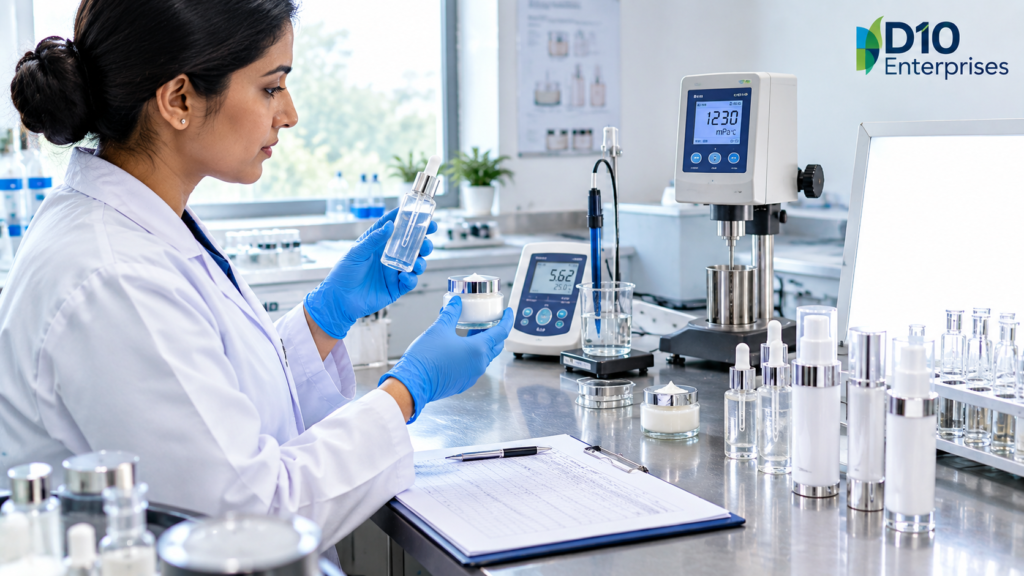
The second is where premium positioning actually comes from. ISO 22716 is an international Good Manufacturing Practices standard built specifically for cosmetics, covering production, control, storage and shipment. It is voluntary in India, which means not every manufacturer bothers with it, but it has been adopted by regulators and brands across the EU, the US and several other markets as the recognised benchmark for cosmetics quality systems. A manufacturer that holds ISO 22716 certification, on top of their mandatory Cosmetics Rules licence, is signalling a more rigorous, documented quality system than one running on the legal minimum alone. If premium positioning matters to your brand, this is a fair question to ask any contract beauty producer directly, not assume from their marketing copy.
D10 lists quality, safety and compliance as a dedicated service area. Ask specifically which certifications and standards back this up.
What D10 Enterprises Lists for Cosmetics
According to its website, D10 Enterprises separates its cosmetics manufacturing into several categories relevant to a premium beauty brand. This includes serum, cream, face scrub, face wash, derma cosmetics, organic cosmetics, herbal cosmetics and colour cosmetics, alongside hair care, personal care and baby products. A Delhi founder planning a tight, premium range, say a serum, a cream and a cleanser, can see the full breakdown on the product catalog before narrowing down a brief.
What a Beauty Brand Contract Manufacturer Should Offer
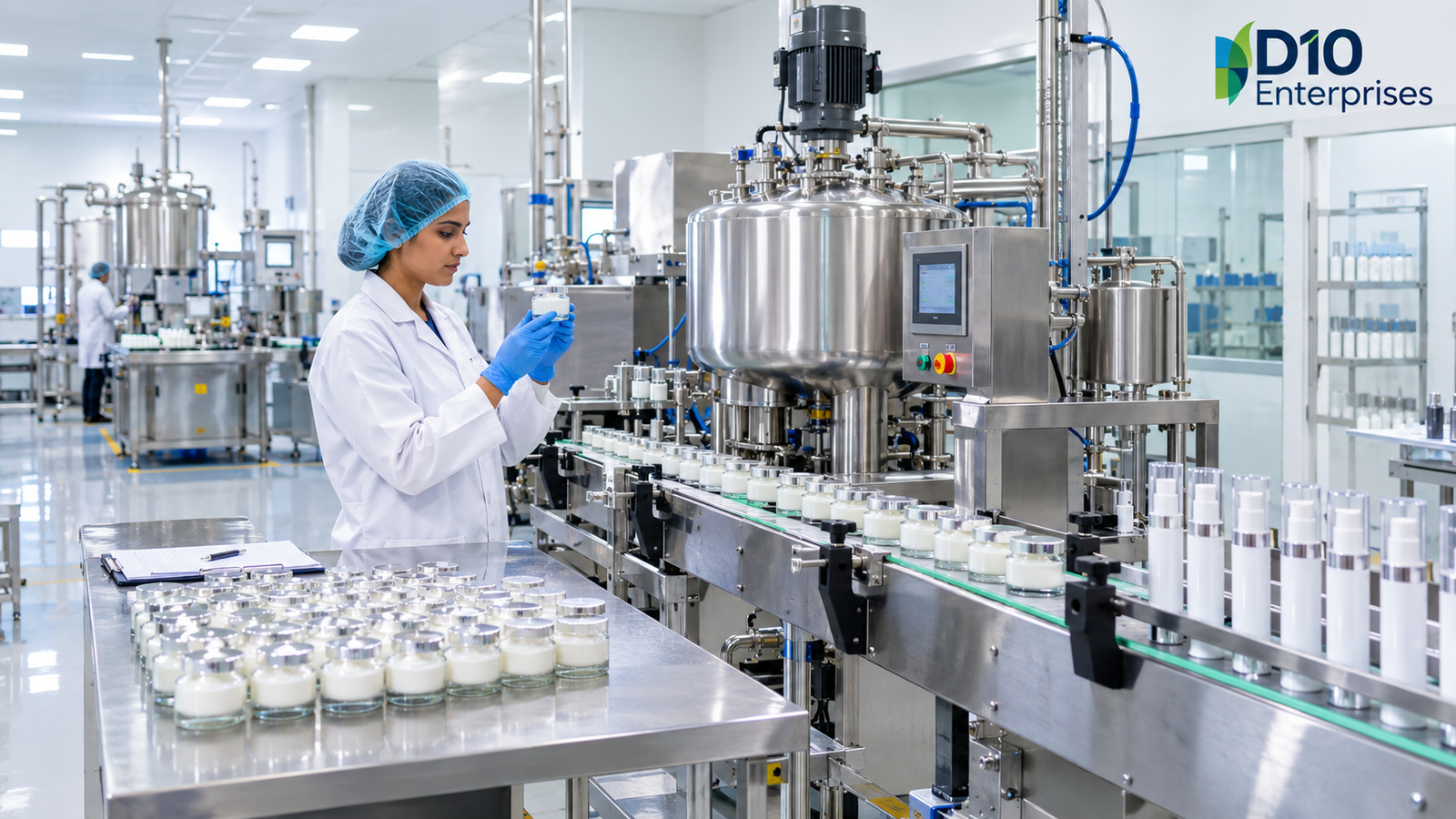
A genuine beauty brand contract manufacturer offers more than filling jars and shipping boxes. Look for a formulation team capable of working with the actives a premium brand actually needs, documented batch testing rather than vague assurances, private labeling so the finished product carries your brand identity, and packaging options that match a premium shelf presence, think airless pumps and glass over basic plastic jars where the formula calls for it.
D10 describes its offer as GMP standard production with quality control, custom formulation solutions, private branding and labeling, loan licensing services and regulatory operations and support. As with any manufacturer, ask to see the actual documentation behind these claims before committing a large first order.
White Label Skincare Services Versus Custom Formulation
White label skincare services mean selecting a formula already in the manufacturer’s range and putting your brand on it. It is the faster, more affordable entry point, useful if your premium positioning will come mainly from packaging, branding and marketing rather than a wholly original formula.
cosmetics manufacturing partner is where a genuinely premium brand usually needs to go eventually, building or adjusting a formula around a specific active ingredient profile, a texture that differentiates you from the mass market, or a fragrance-free version for sensitive skin customers who are often willing to pay more for that reassurance. It takes longer and typically needs a higher minimum order, so weigh this against how differentiated your launch product actually needs to be.
Loan Licensing for a Growing Cosmetics Brand
As a cosmetics brand scales, some founders want more direct regulatory ownership rather than simply buying finished goods under the manufacturer’s own licence. D10 lists loan licensing services as a separate option, letting you hold your own manufacturing licence while using their facility and equipment. This is usually a later-stage consideration rather than a first launch decision, but worth understanding early so you know the path exists.
How the Manufacturing Process Typically Works
Most cosmetics manufacturing projects follow a similar sequence regardless of which manufacturer you choose. You share a brief covering the product type, target actives, texture, finish and expected order size. The manufacturer proposes a formulation and sends samples, often with a round or two of adjustment, particularly for actives sensitive to pH or temperature. Once approved, packaging and label artwork are finalised, production runs in GMP batches, and the batch undergoes testing before dispatch.
For a Delhi based brand, ask specifically how the manufacturer handles stability testing for your climate, since Delhi’s hot summers and cold, dry winters both put real stress on cosmetic formulations and their packaging.
A Quick Comparison Checklist
| Point to check | Why it matters |
|---|---|
| Valid Cosmetics Rules manufacturing licence | Legal minimum to operate |
| ISO 22716 or equivalent GMP certification | Signals a more rigorous quality system |
| Experience with your specific product category | Reduces risk of a first-attempt batch |
| Minimum order quantity | Affects your launch budget |
| Packaging options available | Shapes your premium shelf presence |
| Stability testing for your target climate | Confirms the product holds up over time |
| Dispatch time to Delhi NCR | Impacts your launch and restocking schedule |
What Shapes the Cost of Premium Cosmetics Manufacturing
Several factors genuinely move the price for a premium cosmetics line. The actives and their concentration matter most, premium ingredients cost more than standard ones. Packaging choice has a real effect too, glass and airless pump packaging cost more than simple plastic jars. Batch size, label printing, stability testing and freight all play a part as well. Ask for a cost breakdown by stage, formulation, filling, packaging, labelling and testing, so you can see clearly where a premium price point is actually justified by cost, and where it is simply margin.
Common Mistakes to Avoid
The most common mistake is assuming premium positioning comes from packaging alone, when the formulation and manufacturing standard behind it matter just as much to a discerning customer. Another is skipping stability testing for Delhi’s climate extremes, which can show up months later as separation, texture change or reduced shelf life. A third is choosing a manufacturer purely on price without confirming they hold a valid Cosmetics Rules licence for the specific product category.
Getting Started
Before reaching out to a manufacturer, prepare a short brief: your target product category, preferred actives, texture, packaging direction, expected first order and launch timeline. This helps a manufacturer give you an honest, specific answer rather than a generic quote.
To speak with D10 Enterprises, start with their about page, then reach them through the contact page, by phone on +91-7988374621, or by email at d10enterprisesambala@gmail.com. Their address is 226/2 and 226/3, Ajit Nagar, Ambala Cantt, Haryana 133001. You can also start from the D10 Enterprises homepage contract beauty producer.
Frequently Asked Questions
Does D10 have a facility in Delhi?
No. D10 Enterprises is based in Ambala Cantt, Haryana, and works with Delhi based brand owners remotely.
What is the difference between a Cosmetics Rules licence and ISO 22716?
A Cosmetics Rules licence is the mandatory legal requirement to manufacture cosmetics in India. ISO 22716 is a voluntary international GMP standard that signals a more rigorous quality system beyond that legal minimum.
Can I launch under my own brand name?
Yes. Private branding and labeling is listed as a service on D10’s website.
What is the difference between white label and custom formulation?
White label means selling an existing formula under your brand. Custom formulation means the formula is built or adjusted specifically for your brief.
What product categories does D10 list for cosmetics?
Serum, cream, face scrub, face wash, derma cosmetics, organic cosmetics, herbal cosmetics and colour cosmetics, along with hair care, personal care and baby products.
What should I prepare before contacting a manufacturer?
A brief covering your target product category, preferred actives, texture, packaging direction, order size and launch timeline.